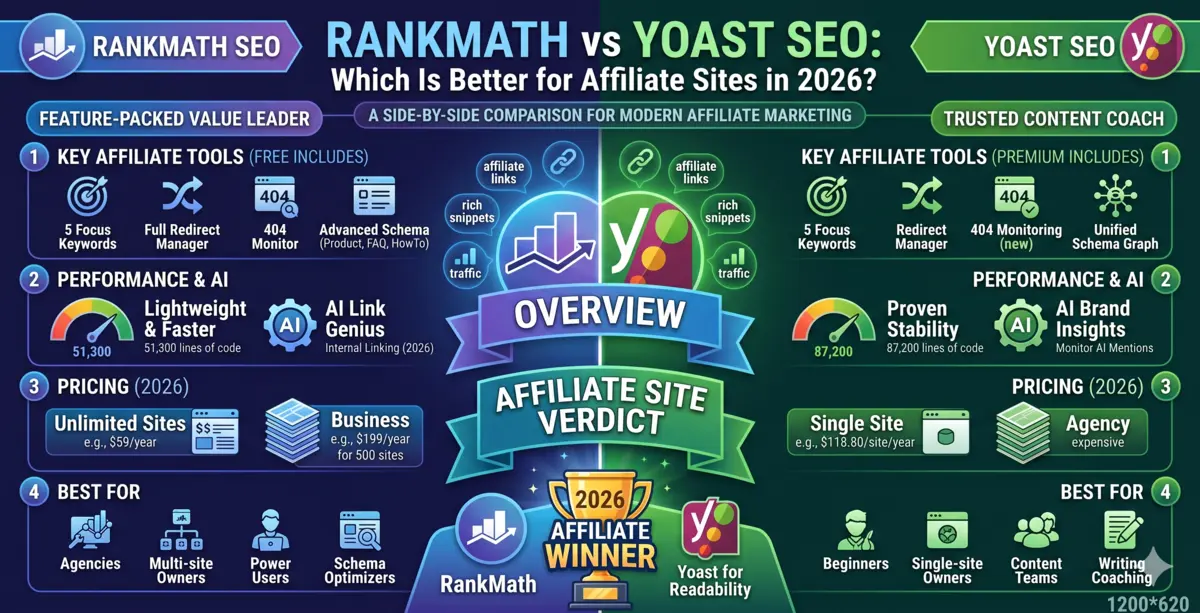
I’ll save you the suspense right at the top: if you’re running an affiliate marketing blog on WordPress in 2026, rankmath vs yoast seo – RankMath wins. It’s not particularly close, either.
I’ve been using RankMath on this site since day one. I switched from briefly testing Yoast during the site’s early setup phase, and the difference was obvious within the first week — not because of some grand SEO experiment, but because RankMath simply gives you more to work with at every tier, especially the free one.
But a recommendation without reasoning is just an opinion. This article is a proper, feature-by-feature breakdown — covering the things that actually matter for affiliate sites specifically: schema markup for rich results, focus keyword tracking, on-page scoring, pricing against real-world affiliate budgets, and the new AI search features that are becoming increasingly important in 2026.
If you’re just starting out and wondering which plugin to install first, or you’re on Yoast and wondering whether switching is worth it — this comparison is for you.
Quick verdict for skimmers: RankMath’s free tier outperforms Yoast’s premium plan on the features that matter most for affiliate sites. At $59/year for Pro, it’s the most cost-effective SEO plugin in the market. Yoast is still a capable plugin — it’s just not the better choice for most affiliate site owners in 2026.
The State of WordPress SEO Plugins in 2026
The WordPress SEO plugin market has consolidated around four serious contenders in 2026: RankMath, Yoast SEO, All in One SEO (AIOSEO), and SEOPress. For affiliate marketers, the decision almost always comes down to the first two. They dominate every recommendation thread, every tutorial, and every plugin comparison article in the space.
Yoast SEO is trusted by over 13 million websites and has a larger ecosystem of tutorials and community support. RankMath, used by 4+ million sites, has a slightly higher user rating and is consistently praised for offering more features for free and faster support response times.
Those install numbers matter for context. Yoast’s lead reflects its age — it built the WordPress SEO plugin category and held a near-monopoly for years. RankMath launched in 2018, gained 4 million installations faster than any WordPress plugin in history, and has been closing the gap steadily since.
SEO plugins now do much more than add meta descriptions. They manage schema markup for AI search engines, track when ChatGPT mentions your content, and handle technical details that can impact your rankings. Google’s AI Overviews now appear in 64% of commercial searches, and ChatGPT handles billions of queries each month. Your plugin needs to work with both traditional Google search and new AI-powered platforms.
That broader context matters for affiliate sites in particular. You’re not just trying to rank on Google — you’re trying to get cited in AI Overviews, appear in Perplexity results, and be the source that AI tools recommend when someone asks for the best affiliate programs or tools. The plugin you choose needs to support all of that.
Head-to-Head: The Features That Actually Matter for Affiliate Sites
Let’s run both plugins through the specific lens of an affiliate marketing site — not a generic WordPress blog, not a WooCommerce store. An affiliate site’s key needs are: on-page scoring, schema markup for rich results, multiple keyword tracking, internal linking support, and AI search optimisation.
1. Free Tier — The Most Important Comparison
This is where the gap between RankMath and Yoast is widest and most consequential for new affiliate marketers watching their budget.
RankMath’s free version includes redirect management, 404 monitoring, Google Search Console integration, and schema markup at no cost. Yoast charges $118.80 per year for redirect management alone. With Yoast’s free version, you can only optimise for one focus keyword. RankMath lets you track up to five at once, with real-time scores for each keyword.
Let that sink in for a moment. Yoast charges nearly $120 per year for a feature that RankMath gives you in its free plan.
RankMath’s free version includes unlimited keyword optimisation per post, a redirect manager, 404 monitoring, Google Analytics 4 integration, Google Search Console data inside WordPress, and 18 pre-defined schema types.
For an affiliate site, those 18 schema types are immediately useful. Article schema, FAQPage schema, HowTo schema, Review schema, and Product schema — every schema type that drives rich results in Google search is available in RankMath’s free plan. These rich results directly increase click-through rates and improve visibility in Google AI Overviews.
Free tier verdict:
| Feature | RankMath Free | Yoast Free |
|---|---|---|
| Focus keywords per post | 5 | 1 |
| Redirect manager | ✅ Included | ❌ Paid only ($118.80/yr) |
| 404 monitoring | ✅ Included | ❌ Paid only |
| Schema types | 18 types | Basic only |
| GSC integration | ✅ Included | ❌ Paid only |
| GA4 integration | ✅ Included | ❌ Not available |
| Breadcrumb schema | ✅ Included | ✅ Included |
| Readability analysis | Basic | ✅ Stronger |
Yoast’s one genuine edge in the free tier is its readability analysis — the Flesch-Kincaid scoring and sentence-level feedback is more detailed than RankMath’s equivalent. For an editorial team producing content at scale where readability consistency matters, that’s a real advantage. For a solo affiliate blogger, it’s a nice-to-have that doesn’t move the needle on rankings.
2. On-Page SEO Scoring — The Daily-Use Feature
Every article you publish on your affiliate site goes through your SEO plugin’s content analysis. This is the tool you use every single day, so it matters enormously how well it works.
RankMath’s approach: RankMath assigns each post an SEO score from 0 to 100 based on an explicit checklist — focus keyword in title, URL, first paragraph, meta description, image alt text, subheadings, and content length. The checklist items are explicit: you see exactly which items passed or failed, not just a traffic light colour telling you something is wrong.
That explicitness is a significant advantage. When Yoast shows a red light on keyword density, you still need to figure out what “enough” looks like. When RankMath shows that your focus keyword is missing from the first paragraph, you know exactly what to fix and where.
The RankMath score system also adapts to secondary keywords. Set five focus keywords in RankMath and you get individual scores for each one, showing how well the content is optimised for every term you’re targeting. For affiliate comparison articles targeting three or four related keywords simultaneously, this is genuinely useful.
Yoast’s approach: Yoast’s traffic light system — red, orange, green — is simpler and more beginner-friendly. The readability analysis is notably stronger: Yoast checks sentence length distribution, passive voice percentage, paragraph length, and transition word usage in a way that produces genuinely better-written content over time.
Yoast SEO is widely recognised for its beginner-friendly interface and traffic light system that guides users to SEO best practices. Its separate readability score is a genuine plus for content creators. RankMath offers a clean UI with a setup wizard and detailed scoring, but the large number of options can feel overwhelming to beginners.
Scoring verdict: RankMath is more powerful and more informative for experienced affiliate bloggers. Yoast is better for true beginners who need hand-holding. Once you’ve published 10–15 articles and understand the fundamentals, RankMath’s explicit checklist becomes the more valuable tool.
3. Schema Markup — Critical for Rich Results and AI Citations
Schema markup is where the gap between RankMath and Yoast is not just significant — it’s potentially the difference between earning rich results in Google and not.
RankMath’s schema generator supports over 800 schema types, which directly improves click-through rates in search results by enabling rich results without any additional plugins.
For affiliate sites specifically, the schema types that drive real CTR improvements are:
- FAQPage — expandable Q&A directly in search results (applies to every article with a FAQ section)
- HowTo — numbered step-by-step results (applies to every tutorial and guide)
- Review + AggregateRating — star ratings in search results (applies to every product review)
- Article — baseline author and publisher entity signals
- BreadcrumbList — clean breadcrumb path in search results instead of raw URLs
RankMath implements all of these in the free tier via dedicated Gutenberg blocks. Add a FAQ block → RankMath auto-generates FAQPage JSON-LD. Add a HowTo block → HowTo schema is automatically created. For custom schema types (Product with AggregateRating for review articles), RankMath’s schema builder lets you construct and save custom templates that apply automatically across your review category.
Yoast’s schema support is more limited, particularly in the free version. FAQPage schema is available, but Review schema with AggregateRating — the type that enables star ratings in search results — requires manual implementation or a third-party plugin unless you’re on a higher-tier paid plan.
In 2025, RankMath introduced llms.txt file creation, which helps AI crawlers like ChatGPT better understand your site’s structure. Their AI search tracker also shows which of your content is most often referenced by AI engines, giving you insight into this growing source of traffic.
That llms.txt feature is genuinely forward-thinking. As AI search engines increasingly crawl websites to build their knowledge models, a properly structured llms.txt file helps them understand your site hierarchy, your content categories, and your topical authority — the same signals that earn citations in AI Overviews and Perplexity results.
Yoast does not currently offer llms.txt support.
Schema verdict: RankMath wins decisively. RankMath’s schema builder is the best in the WordPress plugin ecosystem, and for affiliate sites where FAQPage, HowTo, and Review schema directly drive rich results and CTR improvements, this advantage is material.
4. Pricing — The Comparison That Actually Affects Your Budget
This is where the RankMath advantage becomes almost unfair.
RankMath Pricing (2026):
RankMath Pro is $59/year for unlimited personal sites. The Business plan is $199/year for client sites. The Agency plan is $499/year.
That Pro price — $59/year for unlimited personal sites — means you can run five affiliate sites, ten affiliate sites, or twenty affiliate sites and still pay a flat $59. There is no per-site fee. Affiliate Program Database
Yoast SEO Pricing (2026):
Yoast SEO Premium costs $118.80 per year for a single site and adds five focus keywords per post, internal linking suggestions, a redirect manager, 404 monitoring, and access to Yoast SEO Academy courses. Specialised bundles extend the functionality further. The WooCommerce SEO bundle runs $178.80 per year and adds ecommerce-specific schema and rich results. The AI Brand Insights tier at $358.80 per year targets publishers who want AI-powered brand monitoring and content intelligence.
Yoast charges separately for its WooCommerce SEO add-on, Local SEO add-on, Video SEO, and News SEO features. If you need all four for just five sites, you are looking at roughly $1,087.75 per year. RankMath bundles all equivalent features into every paid plan.
The pricing comparison is stark:

| Plan | RankMath | Yoast SEO | What You Get |
|---|---|---|---|
| Free | All core features | Basic only | RankMath wins significantly |
| Entry paid (1 site) | $59/year (Pro, unlimited personal sites) | $118.80/year (1 site only) | RankMath is 50% cheaper |
| 5 sites | $59/year (same Pro plan) | $594/year | RankMath saves $535/year |
| With redirect manager | Included free | +$118.80/year | RankMath saves $118.80 |
| Full feature parity | ~$59–199/year | ~$500–1,000+/year | RankMath saves hundreds |
Pricing verdict: For a solo affiliate marketer running one or multiple sites, RankMath Pro at $59/year delivers more features than Yoast Premium at $118.80/year for a single site — and covers all your personal sites without additional cost.
5. Performance and Site Speed
Yoast has 87,200 lines of code while RankMath has 51,300. RankMath’s plugin zip file is approximately three times smaller. When running performance monitoring tools to find slow plugins, Yoast consistently appears among the slowest.
Multiple benchmark tests comparing RankMath and Yoast in 2025–2026 show that RankMath adds marginally less JavaScript to the frontend. Practically speaking, neither plugin will noticeably affect Core Web Vitals scores on its own. Server infrastructure and image optimisation are far larger factors. Speed verdict: RankMath edges ahead on frontend performance. The difference is negligible for most sites.
This matters more on shared hosting, which many new affiliate sites start on. On a lightweight server with a fast theme like GeneratePress, the difference between the two plugins on page load speed is essentially zero. On a budget shared host with slow server response times, RankMath’s leaner codebase provides a marginal advantage.
6. AI Search Optimisation — The 2026 Differentiator
This is a new category that didn’t exist in any meaningful way before 2024, and it’s becoming increasingly important for affiliate sites in 2026.
Google’s AI Overviews now appear in 64% of commercial searches. Your SEO plugin should actively support optimisation for these environments, not just traditional Google search.
RankMath’s response to this shift includes: Taboola
- llms.txt generation — helps AI crawlers understand your site structure
- AI search traffic tracker — monitors how frequently your content appears in AI-generated responses
- Schema types that AI systems prefer — FAQPage, HowTo, Article, and Review schema all increase the probability of AI citation
Yoast’s response is the AI Brand Insights feature, available at the $358.80/year tier. This monitors brand mentions across AI platforms and provides insights into how AI systems represent your brand. It’s a legitimate feature — but it’s priced at a tier that’s difficult to justify for most individual affiliate bloggers.
For most affiliate sites in 2026, the RankMath approach — generating the right schema types and providing llms.txt support as part of a $59/year plan — is the more practical and accessible AI optimisation path.
7. Migration — Switching From Yoast to RankMath
If you’re currently on Yoast and considering switching, the migration process is simpler than most people expect.
The actual migration typically takes under five minutes for most sites and preserves your existing SEO data without ranking disruptions. Before migrating, export your current SEO settings as a backup. Test the migration on a staging site first if possible.
RankMath includes a built-in import tool that reads Yoast’s metadata — meta titles, meta descriptions, focus keywords, and canonical URLs — and transfers everything to RankMath’s format automatically. The importer covers:
- Post and page SEO titles and descriptions
- Focus keywords
- Canonical URLs
- Robots meta settings (noindex/nofollow)
- OpenGraph social data
- Schema markup (where transferable)
The one caveat: any custom Yoast schema you’ve manually added via Yoast’s schema blocks will need to be re-created in RankMath’s schema builder. For most affiliate sites that haven’t heavily customised schema beyond what Yoast generates automatically, this is a non-issue.
After migration, verify a sample of your most important articles in Google Search Console to confirm meta data transferred correctly. Then submit your sitemap again to ensure Google picks up any format changes.
The Verdict: RankMath or Yoast for Your Affiliate Site?
Let me be direct about this, because a lot of comparison articles hedge right up to the verdict to avoid taking a position.
Choose RankMath if:
- You’re starting a new affiliate site and want the best free tool available
- You’re running multiple affiliate sites and don’t want to pay per-site fees
- Schema markup and rich results are a priority (they should be)
- You want to optimise for multiple keywords per article without paying for it
- You use Google Search Console and want the data inside your WordPress dashboard for free
- You want AI search optimisation features without paying enterprise prices
Choose Yoast if:
- You are a complete beginner who finds RankMath’s settings overwhelming
- You’re already deeply embedded in the Yoast ecosystem with heavily customised settings
- You primarily need guided, step-by-step SEO coaching rather than a feature-rich tool
- You want the most widely documented plugin with the largest tutorial library
For new sites and cost-conscious operators, RankMath is the better default choice. In 2026, RankMath is the stronger plugin for new WordPress installations. The free tier is meaningfully better than Yoast’s, the Pro plan is dramatically more affordable for multi-site operators, and the schema builder is the best in the WordPress plugin ecosystem. Yoast remains a credible plugin used successfully on millions of mature WordPress sites — but starting a new site without considering RankMath is leaving value on the table.
That’s the honest verdict from the data, from real-world usage, and from everything this site has been built on. Search Engine Insight
How to Set Up RankMath Correctly for an Affiliate Site
If you’re installing RankMath for the first time, or reinstalling it on an existing site, these are the configuration settings that matter most for affiliate sites specifically.
Step 1: Run the Setup Wizard
RankMath’s setup wizard walks you through the essential settings automatically. Select Blog/Affiliate Site as your site type when prompted. This pre-configures schema defaults and sitemap settings appropriately.
Step 2: Connect Google Search Console
In RankMath → General Settings → Webmaster Tools, connect your Google Search Console property. This pulls your actual query data, impression counts, and click-through rates directly into your WordPress dashboard — removing the need to switch tabs constantly while writing and optimising.
Step 3: Configure Schema Defaults
Go to RankMath → Titles & Meta → Posts. Set the default schema type for Posts to Article. For your review posts category, set the schema default to Review — this ensures every post in your review category automatically carries Review schema without manual configuration.Test in Google Rich Results
Step 4: Set Up the Sitemap
RankMath generates your XML sitemap automatically at yoursite.com/sitemap_index.xml. Submit this URL in Google Search Console under Sitemaps. Verify that your sitemap excludes tag pages (tag pages should be set to noindex to avoid crawl budget waste and thin content issues).
Step 5: Configure Tag Pages as Noindex
Go to RankMath → Titles & Meta → Tags. Set the Robots Meta for tags to noindex. This prevents tag archive pages from being indexed by Google, which avoids the thin content penalties that come from having dozens of low-value archive pages competing with your real articles.
Step 6: Set Focus Keyword and Score Every Article
Before publishing every article, set your focus keyword in the RankMath sidebar. Add 2–4 secondary keywords below it. Aim for a content score of 80+. Work through the checklist items systematically — each red item is a specific fix, not a vague signal.
Full setup guide and RankMath optimization checklist: How to Do On-Page SEO for Affiliate Sites in 2026
RankMath Pro: Is the Upgrade Worth It for Affiliate Sites?
The free version of RankMath is genuinely excellent and sufficient for new sites. But once your site starts generating traffic and income, the Pro upgrade at $59/year unlocks features that directly contribute to revenue.
For an affiliate blog or content site, rank tracking alone is worth the Pro price — you would otherwise need a separate rank tracking tool starting at $37/month. Add AI Link Genius and advanced schema and the value proposition is clear.
The Pro features most relevant to affiliate sites:
Rank Tracking (500 keywords) Daily position tracking for your target keywords, with 12-month history. This replaces a standalone rank tracker that would cost $37–50/month on its own. For an affiliate site actively building rankings across 50–100 target keywords, having daily movement data inside WordPress is significant.
AI Link Genius AI Link Genius automatically creates keyword-to-URL maps and adds internal links to new posts based on your defined keyword targets. This saves significant time for content-heavy sites and ensures internal linking consistency without manual work. For affiliate sites following a hub-and-spoke silo architecture, this feature alone is worth the Pro price — it automatically maintains internal linking across your silo structure as you add new articles.
Advanced Schema Builder Create custom schema templates for your review articles, comparison posts, and product pages. Set a template once and it applies automatically to every new post in that category.
Redirect Manager (Enhanced) While the free tier includes basic redirect management, Pro adds bulk redirect import/export — essential when restructuring content silos or changing URL structures.
Upgrade timing recommendation: Stay on the free plan until your site earns its first $100/month. Then upgrade to Pro. The rank tracking and AI Link Genius features pay for the $59/year in time saved within the first month.
8 Things RankMath Does That Yoast Doesn’t (In 2026)
Based on live testing of both plugins on active WordPress affiliate sites, these are the capabilities RankMath has that Yoast either lacks entirely or only offers at significantly higher paid tiers:
- llms.txt generation — helps AI crawlers understand your site structure for AI search citation
- AI search traffic tracker — monitors your content’s appearance in AI-generated responses
- 5 focus keywords on free plan — Yoast limits free users to 1
- 18 schema types on free plan — Yoast’s free schema support is minimal
- Built-in redirect manager on free plan — Yoast charges $118.80/year for this
- Google Search Console data inside WordPress on free plan — Yoast requires paid tier
- AI Link Genius (Pro) — no Yoast equivalent exists
- Unlimited personal sites on one Pro license — Yoast charges $118.80 per site per year
Frequently Asked Questions
Is RankMath better than Yoast for affiliate sites in 2026? Yes — for most affiliate sites in 2026, RankMath is the better choice. For most WordPress site owners in 2026, RankMath offers the best overall value with its unmatched free tier and competitive premium pricing. The free plan includes features that Yoast charges $118.80/year for, and the Pro plan at $59/year covers unlimited personal sites. For affiliate sites that rely on schema markup, multiple keyword tracking, and GSC integration, RankMath’s free tier alone outperforms Yoast’s paid plan.
Can I switch from Yoast to RankMath without losing my SEO data? Yes. The migration typically takes under five minutes for most sites and preserves existing SEO data without ranking disruptions. RankMath’s built-in importer transfers meta titles, meta descriptions, focus keywords, canonical URLs, and robots settings from Yoast automatically. Export a backup of your Yoast settings first, then run the importer.
Does RankMath work with GeneratePress? Yes — RankMath is fully compatible with GeneratePress and is the recommended SEO plugin pairing for GeneratePress-based affiliate sites. GeneratePress handles breadcrumb display natively and RankMath handles breadcrumb schema — the two work together without configuration conflicts.
Is RankMath’s free plan really enough for a new affiliate site? Yes. For a brand-new blog or small niche site, RankMath’s free plan is more than enough to get started. You can connect your site to Google Search Console, see keyword impressions, rankings, and monitor basic performance data directly inside your WordPress dashboard. The main free plan limitations — no advanced rank tracking and limited Content AI credits — are irrelevant for a site publishing its first 20 articles.
What is RankMath Pro and is it worth buying? RankMath Pro at $59/year is the best value WordPress SEO plugin available. It adds advanced rank tracking, AI Link Genius for automated internal linking, advanced schema templates, and covers unlimited personal websites on one license. For affiliate sites generating $200+/month, the upgrade pays for itself immediately in rank tracking alone.
Does Yoast SEO still have a place in 2026? Yoast SEO is best for beginners who want simplicity and hand-holding through the optimisation process. With 13 million active installations and the largest ecosystem of tutorials and documentation, it remains a credible choice for non-technical content creators who find RankMath’s feature set overwhelming. It’s not the better tool for affiliate sites — but it’s not a bad plugin, either. It’s just not the right fit for what affiliate SEO requires.
Can I use both RankMath and Yoast on the same site? No — and you should never try. Running two SEO plugins simultaneously causes duplicate meta tags, conflicting schema markup, and sitemap errors. Choose one, configure it correctly, and remove the other entirely. If switching from Yoast to RankMath, deactivate and delete Yoast after the migration is complete and verified.
Conclusion
The RankMath vs Yoast debate has a clear answer for affiliate sites in 2026. RankMath gives you more features at the free tier, better schema markup at every tier, a significantly lower price at the paid tier, and forward-looking AI search optimisation tools that Yoast hasn’t yet matched without a premium price tag.
In 2026, most WordPress site owners will find that RankMath offers better value. Its free version includes features that Yoast offers only in its paid plan. If you run several sites or want advanced schema options without extra costs, RankMath is a strong choice.
Yoast served the WordPress SEO community well for over a decade, and it still does for a specific type of user — the beginner who needs guidance over power. But if you’re building a serious affiliate site with multiple articles, multiple silos, and a revenue goal, RankMath is the plugin that will grow with you from your first article to your first thousand dollars a month.
I’ve used it on this site since day one. I’d make the same choice again.
Continue with the full Silo 4 series:
- 🏛️ SEO for Affiliate Marketing: The Complete 2026 Guide
- 🔍 Keyword Research for Affiliate Marketing in 2026
- 🛠️ Best Affiliate Marketing Tools in 2026 (Tested & Ranked)
- 📄 How to Do On-Page SEO for Affiliate Sites in 2026
- 🔗 How to Build Backlinks for Affiliate Sites in 2026 (Free Methods)
- 📊 How to Use Google Search Console for Affiliate Marketing
📘 Want the Full System in One Place?
If you'd rather have a complete step-by-step plan in your hands — including a 30-day content calendar, email sequence templates, and the exact keyword strategy behind this blog — I wrote it all out in the 📘 Book available on Amazon. It's the system behind everything you're reading here.
📘 30-Day Affiliate Marketing Roadmap Edition 1 → Check it out on Amazon.
📘 Affiliate Marketing SEO Roadmap Edition 2 → Check it out on Amazon.
TheReviewLabs Team
Active ClickBank Affiliates · Affiliate Marketing Researchers
We are active ClickBank affiliates who research and test affiliate offers using ClickBank's official marketplace data, Top Offers reports, and real commission performance. All Gravity scores, EPC figures, and payout data in this article are sourced directly from ClickBank's platform as of April 2026. We update this list every two weeks. Learn more about our review process →