Affiliate Disclosure: Some links in this article are affiliate links. I may earn a commission if you sign up through them — at no extra cost to you. I only recommend what I’ve personally evaluated.
Let me be honest with you upfront. – Affiliate Marketing vs Dropshipping vs Freelancing
When I first started researching ways to make money online, I spent more time comparing these three models than actually doing anything. Affiliate marketing looked passive and exciting. Dropshipping seemed fast and scalable. Freelancing felt safe because it pays quickly. I kept going in circles — reading one article that convinced me dropshipping was the move, then watching a YouTube video that made affiliate marketing sound like the obvious choice, then talking to a friend who swore freelancing was more reliable. New to affiliate marketing? Start with our business model comparison
If that sounds familiar, this article is for you.
I’m going to break down all three models honestly — the startup costs, the time to first income, what each actually looks like day-to-day, and most importantly, which one makes sense depending on where you are right now.
No hype. No fake income screenshots. Just a straight comparison. Affiliate Marketing vs Dropshipping vs Freelancing
The Quick Answer (If You’re in a Rush) – Affiliate Marketing vs Dropshipping vs Freelancing
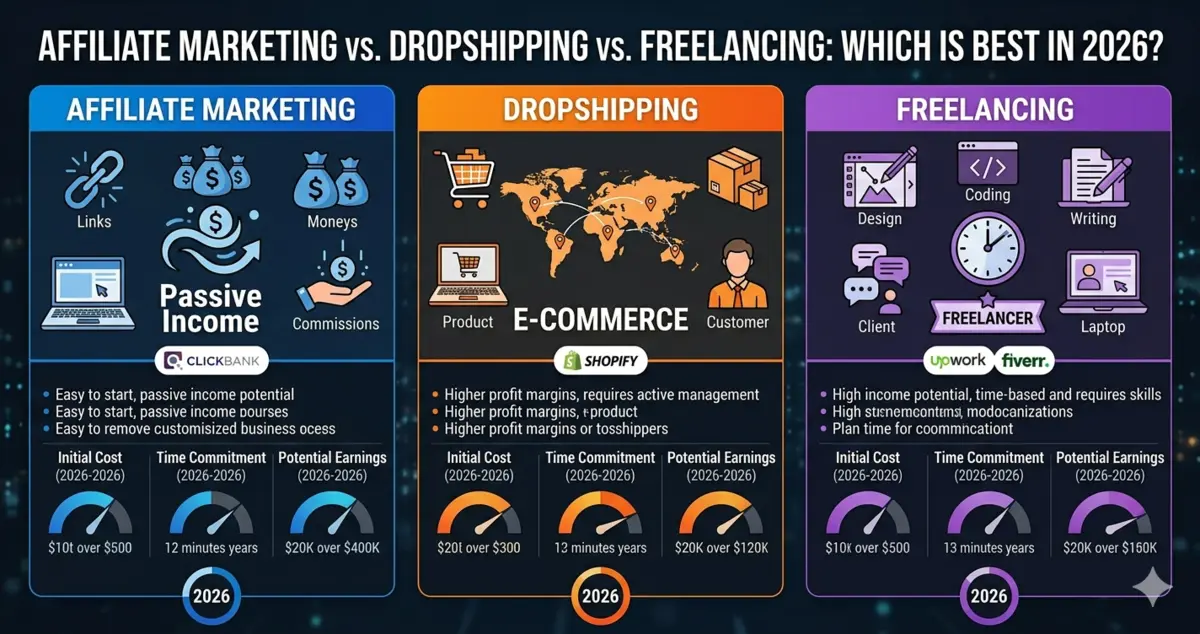
Before we go deep, here’s the short version: Affiliate Marketing vs Dropshipping vs Freelancing?
- Freelancing is the fastest way to make money online. You can earn within days if you have a marketable skill.
- Dropshipping has the highest short-term income ceiling but requires capital, active management, and paid ads to really work.
- Affiliate marketing takes the longest to get started but builds the most passive, compounding income over time — and has the lowest operational complexity of the three.
If you’re a complete beginner with no capital and no existing skill set to sell, affiliate marketing is the easiest place to start. If you already have a skill people pay for, freelancing gets you income fastest. If you’re comfortable with paid advertising and want to build an eCommerce asset, dropshipping is worth considering.
Now let’s actually understand why and the real difference Affiliate Marketing vs Dropshipping vs Freelancing
What Is Each Model, Really? – Affiliate Marketing vs Dropshipping vs Freelancing
Affiliate Marketing
You promote other people’s products using a unique tracking link. When someone buys through your link, you earn a commission — typically between 20% and 75% for digital products, or 3%–15% for physical products.
You don’t handle inventory, customer service, refunds, or shipping. Your entire job is to create content that attracts the right people and point them toward products that solve their problems.
Affiliate marketing now accounts for 16% of global eCommerce sales and more than 80% of brands worldwide now run an affiliate program — which means the products you can promote are nearly unlimited.
The catch: organic affiliate marketing through SEO takes 3–6 months before you see meaningful traffic and income. It’s a long game.
Dropshipping
You build an online store, list products from third-party suppliers, and sell them at a markup. When a customer orders, you forward the order to your supplier and they ship it directly to the customer. You never touch the product.
Dropshipping profit margins typically sit between 20–40% depending on niche and supplier relationships which is higher per sale than most affiliate commissions. But you control the pricing, which is a major advantage.
The catch: you own the customer experience. If the supplier ships late, sends a damaged product, or runs out of stock — you deal with that complaint. Dropshippers still need to manage customer support and customer service if visitors have questions about products or unexpected issues arise. – Shopify
Freelancing
You sell a skill directly to clients — writing, design, web development, video editing, social media management, SEO, whatever you’re good at. Platforms like Upwork, Fiverr, and Toptal make it easy to find clients worldwide.
Freelancing brings quick money — once your work is done, you get paid. There’s generally no waiting period. That’s the biggest advantage over the other two models.
The catch: your income is directly tied to your time. Stop working, stop earning. Affiliate marketing is a passive income source — your blog posts or YouTube videos continue to generate affiliate sales as long as they remain on the web. Freelancing doesn’t offer that. Legiit
Side-by-Side Comparison – Affiliate Marketing vs Dropshipping vs Freelancing
| Factor | Affiliate Marketing | Dropshipping | Freelancing |
|---|---|---|---|
| Startup Cost | $50–$200 (domain + hosting) | $200–$1,000+ (store + ads) | $0 (just your skill) |
| Time to First Income | 3–6 months | 2–8 weeks | Days to 2 weeks |
| Passive Income Potential | ⭐⭐⭐⭐⭐ High | ⭐⭐⭐ Medium | ⭐ Low |
| Scalability | ⭐⭐⭐⭐⭐ Very High | ⭐⭐⭐⭐ High | ⭐⭐ Limited |
| Customer Service Required | ❌ None | ✅ Yes | ✅ Yes (client management) |
| Inventory Management | ❌ None | ❌ None | ❌ None |
| Skills Needed | SEO, content writing | Paid ads, product research | Your specific skill |
| Income Ceiling | Unlimited | Unlimited | Limited by hours |
| Risk Level | Low | Medium | Low |
| Best For | Patient, content-focused beginners | Paid ads people, eCommerce builders | Skilled professionals wanting fast income |
Let’s Talk About Startup Costs Honestly – Affiliate Marketing vs Dropshipping vs Freelancing
This is where most comparisons get it wrong — they quote “$0 to start!” for all three. Here’s the reality: Affiliate Marketing vs Dropshipping vs Freelancing
Affiliate Marketing: You genuinely can start for under $100. A domain name runs about $10–$15 per year, and basic hosting costs $3–$10 per month. That’s your entire overhead. For affiliate marketing, the bare minimum startup costs are genuinely minimal — a domain name runs about $15 per year. You don’t need to buy products, run ads, or have a portfolio to show clients. – Brett Scofield
Dropshipping: The store itself is relatively cheap to set up on Shopify ($29/month). The real cost is traffic. Without organic SEO — which takes months — you need paid ads to get visitors to your store. Facebook Ads, Google Shopping, TikTok Ads — these can easily cost $500–$2,000 per month just to test products and find what converts. Many beginners burn through $300–$500 before making a single sale.
Freelancing: The platform itself is free. Upwork and Fiverr don’t charge you to create a profile. But there’s a hidden cost — the time and effort to build a portfolio, write proposals, and land your first client can take weeks if you’re starting from scratch.
Bottom line: comparing Affiliate Marketing vs Dropshipping vs Freelancing : Affiliate marketing has the lowest financial risk. Freelancing has the lowest financial cost. Dropshipping has the highest financial barrier if you’re relying on paid traffic.
Income Potential: What’s Actually Realistic? – Affiliate Marketing vs Dropshipping vs Freelancing
Let’s look at real income ranges for each model, not the highlight reel. – Affiliate Marketing vs Dropshipping vs Freelancing
Affiliate Marketing Income
Around 10–20% of affiliates make enough to treat it as a primary income, with around 1–5% of top performers reaching six figures. – FirstPromoter
Here’s a more granular breakdown of what’s realistic at different stages:
| Stage | Monthly Income | Timeline |
|---|---|---|
| Beginner | $0–$500 | Months 1–6 |
| Growing | $500–$2,000 | Months 6–18 |
| Established | $2,000–$10,000 | 12–24 months |
| Authority site | $10,000+ | 2–4 years |
The compounding nature of SEO is the real story here. An article you publish today could be generating commissions three years from now — without you touching it again.
Dropshipping Income
Dropshipping can generate income faster, but it’s less predictable. Typical dropshipping profit margins often sit between 20–40% depending on niche and supplier relationships. – Easync
A beginner running a focused product store with $500/month in ad spend might see anywhere from a loss to $1,000 in profit in month one, depending entirely on product-market fit. The highs are higher — but the floor is also lower because ad costs eat into margins aggressively.
Freelancing Income
Freelancing is probably the most predictable of the three. Beginner affiliate marketers on Upwork tend to charge about $25 an hour, while intermediate freelancers with expertise in online marketing strategy and SEO typically command upward of $60 per hour. – Upwork
A freelancer working 20 hours per week at $30/hour is clearing $2,400/month. That’s genuinely achievable within your first 2–3 months if you have a skill people want. The ceiling, though, is your hours. Unless you build an agency, your income is capped by your availability.
The Real Differences Nobody Talks About
Here’s what most comparison articles gloss over: Affiliate Marketing vs Dropshipping vs Freelancing
Ownership
With affiliate marketing, you build your website and your audience. The content you create belongs to you. The email list you grow is yours.
With dropshipping, you’re building a brand and a customer base — which is also yours. But your margins are always competing with suppliers, Amazon, and other dropshippers selling the same items.
With freelancing, you build your reputation and your client relationships. That’s valuable — but the moment you stop delivering work, income stops too.
Flexibility vs. Responsiveness
Affiliate marketing is the most set-it-and-let-it-run model of the three. Once you publish a well-optimized article and it ranks, it earns passively. You’re not tied to client deadlines or store operations.
Dropshipping requires you to stay on top of supplier relationships, pricing changes, and ad performance. A product that converts well today might have supply issues next week.
Freelancing demands responsiveness. Clients expect you to be available, hit deadlines, and communicate regularly. It’s the most “job-like” of the three models.
Stress Level – Affiliate Marketing vs Dropshipping vs Freelancing
This is underrated in most comparisons. Dropshipping has significant operational stress — you’re responsible for a customer experience you don’t fully control. Delayed shipments, wrong items, angry customers — all of that lands on your inbox.
Freelancing has client stress. Revisions, scope creep, chasing invoices — it’s real. Many freelancers eventually burn out from client management.
Affiliate marketing has patience stress. The hardest part isn’t the work itself — it’s publishing consistently for months without seeing income yet. That psychological challenge filters out most people who start.
Which Model Is Best for You? (Honest Assessment)
There’s no universal answer. But there are clear matches depending on your situation: Affiliate Marketing vs Dropshipping vs Freelancing The effectiveness of each method can often hinge on how well you understand privacy practices in online platforms. As consumers become more aware of their data rights, ensuring compliance with these standards is increasingly important. Your choice might also influence how potential customers perceive your brand’s commitment to their privacy.
Choose Affiliate Marketing if:
- You’re a beginner with limited capital
- You enjoy writing, creating content, or reviewing products
- You want income that compounds and eventually becomes passive
- You’re willing to wait 3–6 months before seeing real returns
- You want to build a long-term asset you could eventually sell
Choose Dropshipping if:
- You’re comfortable with paid advertising (or willing to learn it fast)
- You have $500–$1,500 to invest in testing and ads
- You enjoy the product research and eCommerce side of things
- You want faster initial income than SEO-based affiliate marketing provides
- You’re okay with active store management and some customer service
Choose Freelancing if:
- You already have a marketable skill — writing, design, development, marketing
- You need income within the next 30 days
- You’re okay with trading time for money in the short term
- You want to fund another business model (many people freelance to finance their affiliate or dropshipping venture)
- You prefer clear, predictable payments over uncertain commissions
Can You Do All Three? – Affiliate Marketing vs Dropshipping vs Freelancing
Yes — and many successful online entrepreneurs do.
A common path looks like this: Start freelancing to generate quick income. Use that income to fund your affiliate site. Build the affiliate site over 12–18 months while freelancing. Eventually, the affiliate income replaces the freelancing income — and you transition to building passive assets full-time.
Some people add dropshipping later, once they understand paid traffic from their other ventures. The skills transfer well.
The key is not spreading yourself too thin too early. Pick one, get your first results, then consider adding another stream.
Frequently Asked Questions
Which is more profitable — Affiliate Marketing vs Dropshipping vs Freelancing? Long-term, affiliate marketing and dropshipping both have higher ceilings than freelancing because they’re not capped by your hours. Dropshipping can generate larger per-transaction profits, but affiliate marketing has lower overhead and tends to compound better over time. Freelancing is most profitable per hour in the short term.
Can a complete beginner start affiliate marketing in 2026? Yes. Affiliate marketing is one of the most beginner-friendly online business models because it requires no product, no inventory, and no customer service. The main investment is time — creating content and learning SEO. See our full guide on how to start affiliate marketing in 2026 for a complete walkthrough.
Is dropshipping still worth it in 2026? Dropshipping is still viable in 2026, but the days of easily profiting from generic, low-quality products are mostly gone. What works now is finding a focused niche, sourcing quality products, building a real brand, and using data-driven ad targeting. It’s harder than it was five years ago, but people are still building profitable stores.
How long does it take to make money with affiliate marketing vs dropshipping? Dropshipping with paid traffic can generate sales within weeks. Affiliate marketing through SEO typically takes 3–6 months before you see consistent traffic and commissions. Freelancing can generate income within days to weeks if you have a skill clients want.
Which model is best for someone in India or other developing markets? Affiliate marketing is arguably the most accessible globally — you don’t need a local payment processor, you don’t need to deal with import/export logistics, and platforms like ClickBank, JVZoo, and WarriorPlus support international affiliates fully. Freelancing is also highly accessible via Upwork and Fiverr. Dropshipping from India targeting Western markets is possible but has additional logistics complexity.
What’s the easiest online business model for beginners with no experience? Affiliate marketing wins here. You don’t need an existing audience, a product, or capital to get started — just a website, basic SEO knowledge, and consistent content creation. Our best affiliate programs for beginners guide can help you pick the right programs to start with.
Final Verdict – Affiliate Marketing vs Dropshipping vs Freelancing
All three models work. All three have made people financially independent. The question was never “which one is the best?” — it’s “which one is the best fit for where I am right now?”
If you’re reading this on a niche affiliate marketing blog, you probably already know which direction makes the most sense. Affiliate marketing’s biggest strength isn’t just the income potential — it’s that every hour you put in today continues paying you years from now. You’re not trading time for money. You’re building a machine.
That’s what makes it different. And in 2026, with the global affiliate marketing industry valued at $18.5 billion and projected to grow to $31.7 billion by 2031 – Hostinger, it’s not going anywhere.
Start with what matches your current situation. Scale from there.
📘 Want the Full 30-Day System?
The email strategy, content calendar, and keyword plan behind this blog is written up in full in the 30-Day Affiliate Marketing SEO Roadmap on Amazon KDP. If you want a single structured plan rather than piecing it together from articles, it’s all there. → Check it out on Amazon
Have questions about which model suits your situation? Drop them in the comments — happy to give you a straight answer.
→ Related Articles:
- How to Start Affiliate Marketing in 2026 (Complete Beginner’s Guide)
- Best Affiliate Programs for Beginners in 2026
- How to Pick a Profitable Niche for Affiliate Marketing
- How Much Can You Make with Affiliate Marketing?
- Email Marketing for Affiliate Marketers in 2026: The Complete Guide (Tools, Strategy & First Sales)
- What Is ClickBank and How Does It Work for Beginners? (Complete Guide)
- How to Start Affiliate Marketing in 2026 (Ultimate Beginner’s Step-by-Step Guide)
→ “see our guide to the best free traffic sources for affiliate marketing“
→ “for zero-cost traffic strategies, see our best free traffic sources guide”
→ “pair these tools with our free traffic guide“
→ “not sure how to evaluate a niche? See our how to pick a profitable niche guide”
→ “If you’re still choosing your niche, start with our niche selection guide“
→ “first step: picking the right niche — see our guide”
📘 Want the Full System in One Place?
If you'd rather have a complete step-by-step plan in your hands — including a 30-day content calendar, email sequence templates, and the exact keyword strategy behind this blog — I wrote it all out in the 📘 Book available on Amazon. It's the system behind everything you're reading here.
📘 30-Day Affiliate Marketing Roadmap Edition 1 → Check it out on Amazon.
📘 Affiliate Marketing SEO Roadmap Edition 2 → Check it out on Amazon.
TheReviewLabs Team
Active ClickBank Affiliates · Affiliate Marketing Researchers
We are active ClickBank affiliates who research and test affiliate offers using ClickBank's official marketplace data, Top Offers reports, and real commission performance. All Gravity scores, EPC figures, and payout data in this article are sourced directly from ClickBank's platform as of April 2026. We update this list every two weeks. Learn more about our review process →