Affiliate Disclosure: This page contains affiliate links. If you purchase through them, I may earn a commission at no extra cost to you.
Most affiliate marketers treat email as an afterthought. They build a list, send a broadcast whenever they remember, and wonder why nobody’s clicking. – How to Write Affiliate Marketing Emails That Convert lets dig in –
Here’s what they’re missing: email is the single highest-converting channel in affiliate marketing — not because of some secret formula, but because of one simple truth. Every person on your list has given you their contact details and said, in effect, “I trust you enough to let you into my inbox.” That’s a level of permission no social media platform can replicate.
Personalized emails deliver 29% higher open rates and 41% higher click-through rates compared to generic messages. Personalized emails generate 6x higher transaction rates. – Genesysgrowth
But here’s the catch — most affiliate emails read like ads. Subject lines screaming “LIMITED TIME OFFER!!!” Cold, transactional body copy. A wall of text followed by five different calls to action. Recipients tune out immediately, unsubscribe, or worse — mark it as spam.
This guide is about doing it differently. By the end, you’ll have subject line formulas that actually get opened, a proven copy framework that converts without being pushy, 7 ready-to-use email templates for every stage of the customer journey, and a complete 5-email sequence blueprint you can deploy today.
⚡ Quick Answer: What Makes an Affiliate Email Convert?
Three things separate emails that generate commissions from emails that get ignored:
- A subject line that earns the open — curiosity, specificity, or personal relevance
- Copy that leads with value before the ask — help first, promote second
- One clear call to action — single link, single goal, no decision fatigue
Everything else — design, length, send time — is secondary. Get these three right and your affiliate emails will convert. Get them wrong and even a list of 10,000 won’t move the needle.
Why Email Is Your Highest-Value Affiliate Asset – How to Write Affiliate Marketing Emails That Convert
Before the templates — understand why email matters more than any other traffic source in your toolkit.
Email flows generate nearly 41% of email revenue from just 5.3% of sends. – Klaviyo That ratio is extraordinary — a tiny fraction of your emails, sent to the right people at the right moment, drives nearly half of all email revenue. That’s what automation and sequencing does.
The median email open rate across all industries is 43.46%. – MailerLite Compare that to the organic reach of a Facebook Page (around 2–6%) or a tweet (seen by roughly 1–3% of followers). Email puts your message in front of nearly half your audience every single time you send.
And unlike every other traffic source — SEO, Pinterest, TikTok, YouTube — your email list belongs to you. Google can change its algorithm. TikTok can get banned. Pinterest can update its feed. Your email list is immune to all of that.
If you haven’t started building yours yet, our guide on how to build an email list fast covers the full process from zero to your first 500 subscribers. Once your list is growing, this guide shows you how to turn it into a commission engine.
The 3-Part Framework Every Converting Affiliate Email Needs – How to Write Affiliate Marketing Emails That Convert
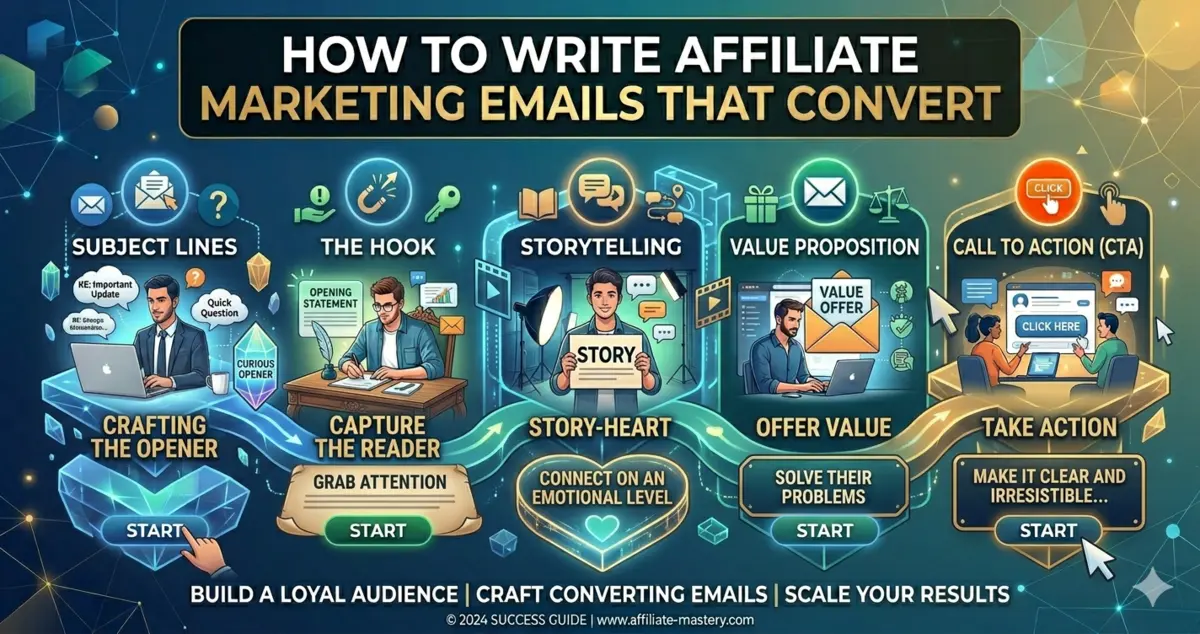
How to Write Affiliate Marketing Emails That Convert – Before templates, understand the framework. Every high-converting affiliate email follows the same three-part structure regardless of length, product, or niche.
Part 1: The Hook (Subject Line + Preview Text)
Your email doesn’t start with your first sentence. It starts in the inbox, before anyone’s clicked open. The subject line is your headline. The preview text is your subheadline. Together they have one job: earn the click to open.
Welcome emails achieve exceptional 83.63% open rates and a 16.60% click-through rate. That’s not because welcome emails are magic — it’s because the subscriber is expecting them and actively curious. Your regular promotional emails need to manufacture that same curiosity.
Subject line formulas that work for affiliate emails:
| The Specific Result | “How I made my first $300 commission with zero paid ads” |
| The Honest Confession | “I almost promoted this product — then I checked the refund rate” |
| The Curiosity Gap | “The ClickBank product nobody’s talking about (Gravity: 164)” |
| The Direct Benefit | “This free tool builds your email list 3x faster” |
| The Question | “Are you promoting the wrong affiliate platform?” |
| The Time Peg | “What’s working on ClickBank this week (April 2026)” |
| The Contrast | “Why I stopped promoting high-Gravity products (and what I do instead)” |
What to avoid: All-caps, excessive exclamation marks, words like “FREE!!!” or “URGENT” — these trigger spam filters and train your audience to ignore you. Words like “Free!!!” or “Urgent” can send emails straight to promotions or junk folders.
Preview text tip: Your preview text should complete or contrast the subject line — not repeat it. Subject: “I almost promoted this product” → Preview: “…then I actually read the sales page.” That tension drives opens.
Part 2: The Body (Value Before the Ask)
The body of your affiliate email has one purpose: build enough trust and curiosity that clicking your link feels like the obvious next step — not a surrender to a sales pitch.
The structure that works is called PAS + Bridge:
- P — Problem: Open with a pain point your reader recognizes
- A — Agitate: Make that problem feel real and relevant right now
- S — Solution: Introduce the product as a potential fix
- Bridge: Connect their situation to the product naturally before the CTA
This isn’t manipulation. It’s the structure of every helpful recommendation humans make — “I know you’re struggling with X, I found something that helped me with exactly that.”
The 80/20 rule applies — 80% of your emails should provide genuine value through tips, educational content, or exclusive insights, while only 20% should focus on direct promotion.
This ratio matters. If every email you send contains an affiliate link, your list trains itself to filter you out. When you lead with value consistently and promote selectively, every promotional email carries the accumulated trust of every helpful email before it.
Body copy rules:
- Write like you’re texting a smart friend — not presenting to a boardroom
- Keep paragraphs to 2–3 lines maximum for mobile readability
- Use “you” far more than “I” — make it about them
- Tell a micro-story when possible — a 3-sentence anecdote converts better than 3 feature bullets
- One affiliate link, used 2–3 times (once early, once late, once in a PS)
Part 3: The CTA (One Action, No Exceptions)
Emails with a single CTA can increase clicks by up to 371%. The same CTA can appear in multiple places throughout the email — near the top for scanners and one at the bottom for readers. Same CTA, just accessible. – HubSpot
The most common affiliate email mistake is including multiple links to different products, or multiple CTAs asking people to do different things. Every additional option reduces the chance of any action happening at all.
CTA formula that works:
[Action verb] + [specific outcome] + [low-friction framing]
- “Check out the full breakdown here → [link]”
- “See why this product has the highest EPC on ClickBank right now → [link]”
- “Read my honest review before you decide → [link]”
- “Get the free guide here (no opt-in required) → [link]”
Notice none of these say “BUY NOW.” You’re driving them to your review page or the product page — the sales letter does the closing. Your job is just to earn the click.
5-Email Welcome Sequence Blueprint (Copy and Customize) – How to Write Affiliate Marketing Emails That Convert
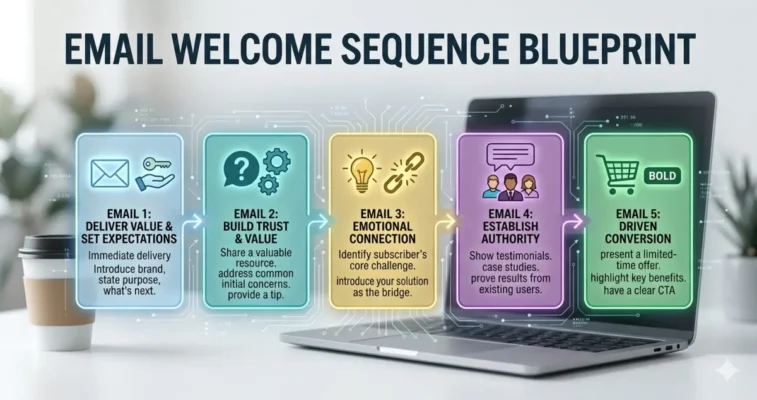
Your welcome sequence is the most valuable automation you’ll ever build. Automated welcome emails dramatically outperform standard campaigns with an 83.63% open rate. Every new subscriber is most engaged in the first 48–72 hours. This is your window to build trust before you ever promote anything.
Here’s a complete 5-email blueprint for an affiliate marketing audience:
Email 1 — Day 0 (Immediate): Deliver and Delight
Subject: Your [lead magnet name] is here — plus one thing I wish someone told me
Body: Hey [First Name],
Welcome — your [free guide / checklist / resource] is attached below.
[LINK TO LEAD MAGNET]
While you’re getting started, here’s something I wish someone had told me when I first got into affiliate marketing: the platform you promote on matters almost as much as the product you choose.
Most beginners spend weeks on the wrong one. Tomorrow I’ll send you a quick breakdown of the three platforms where affiliates are actually making money in 2026 — and one I’d avoid completely.
Talk soon, [Your Name]
P.S. Hit reply and tell me one thing you’re struggling with right now. I read every reply.
Why this works: It delivers the promised value immediately, sets expectations for what’s coming next, opens a conversation, and ends with a teaser that makes Email 2 feel anticipated rather than intrusive.
Email 2 — Day 1: Pure Value (No Promotion)
Subject: The honest truth about ClickBank vs JVZoo vs WarriorPlus
Body: Hey [First Name],
Yesterday I promised a breakdown of the platforms worth your time. Here it is — no affiliate links in this one, just the honest picture.
ClickBank — best for beginners. Huge marketplace, no approval needed for most products, 60-day cookie. The health and spirituality niches are converting exceptionally well right now.
JVZoo — best if you’re in the internet marketing / software niche. Faster payouts, but product quality varies more. Vet carefully before promoting.
WarriorPlus — best for launch-jacking and product launch promotions. Huge MMO community, instant PayPal payouts, but high competition.
I’ve written a full comparison if you want the deep version: [LINK TO JVZoo vs WarriorPlus vs ClickBank article]
Tomorrow: the exact type of email that generates the most affiliate clicks — with a real example.
[Your Name]
Why this works: Pure value, no ask. Links to your own content rather than a product. Builds authority and drives traffic to your review content simultaneously.
Email 3 — Day 3: Story + Soft Intro
Subject: The first commission I ever earned (and what almost stopped it)
Body: Hey [First Name],
My first affiliate commission was $37.40.
I remember staring at the notification thinking — this actually works. Someone I’d never met, in a country I’d never been to, had bought a product based on something I wrote.
What almost stopped it: I’d nearly quit the week before. I’d published eight articles and earned exactly nothing. I was convinced the whole thing was a scam.
That eighth article is the one that converted. It was a review of a ClickBank product in the health niche — honest, specific, and written for someone who was already 80% ready to buy. I just pushed them the last 20%.
If you’re in that “nothing’s working yet” phase right now — I wrote something that might help: [LINK TO ARTICLE ON HOW MUCH CAN YOU MAKE WITH AFFILIATE MARKETING]
More on what that review article looked like tomorrow.
[Your Name]
Why this works: Personal story creates emotional connection. Honest about the struggle — not a fake “I made $10k in week one” narrative. Links to your own content while building anticipation for Email 4.
Email 4 — Day 5: First Soft Promotion
Subject: The ClickBank product making affiliates $218 per sale right now
Body: Hey [First Name],
I mentioned in my last email that the product I promoted was in the health niche. That’s still where the highest-paying opportunities are in 2026.
The current leader is CitrusBurn — a once-daily supplement for women over 40 targeting stubborn weight gain. Average affiliate payout: $218 per sale. No approval required.
I’ve tested the sales page personally. It’s clean, uses a real VSL, has strong social proof, and makes specific claims it can substantiate. Low refund risk.
Here’s my full breakdown of the top ClickBank health products right now: [LINK TO BEST CLICKBANK PRODUCTS ARTICLE]
If you want to start there, that’s exactly where I’d begin.
[Your Name]
P.S. If health isn’t your niche, I’ve also covered JVZoo and WarriorPlus products separately — links are in that article.
Why this works: First real promotion comes after 3 emails of pure value. Product is recommended with honest reasoning. Links to your review article (not directly to the product) — your article earns the click and the trust.
Email 5 — Day 7: Resource + Next Steps
Subject: Everything I’ve sent you this week (plus what’s coming next)
Body: Hey [First Name],
Quick roundup of everything from this week in case anything got buried:
📌 Your [lead magnet]: [LINK] 📌 ClickBank vs JVZoo vs WarriorPlus comparison: [LINK] 📌 How much can you actually make with affiliate marketing: [LINK] 📌 Top ClickBank health products right now: [LINK]
Next week I’m covering free traffic — specifically the sources that are converting for affiliates right now without spending a cent on ads. Pinterest and Quora are doing more work than most people realize.
If there’s anything specific you’d like me to cover — or if you have a question about getting started — just reply to this email.
[Your Name]
Why this works: Consolidates your best content in one place, drives multiple page visits, sets expectations for the next sequence, and opens a genuine two-way conversation.
7 Plug-and-Play Affiliate Email Templates
Use these templates as starting points — personalize with your own voice and specific product details.
Template 1 — Honest Product Review Email
Subject: I spent a week testing [Product] — here’s what I found
Body: Hey [First Name],
I’ve been testing [Product Name] for the past [X days/weeks] and wanted to share what I actually found — good and bad.
The good: [2–3 genuine benefits in plain English]
The not-so-good: [1 real limitation — honesty builds trust]
Who it’s best for: [specific audience]
If that sounds like you, here’s my full breakdown: [LINK]
If it doesn’t — no worries. I’ll be sharing [alternative topic] next week that might be a better fit.
[Your Name]
Template 2 — Comparison Email
Subject: [Platform A] vs [Platform B] — which one actually pays more?
Body: Hey [First Name],
Quick one today — I keep getting asked about [Platform A] vs [Platform B], so I put together a side-by-side comparison.
The short version: [1 sentence summary of the key difference]
But the full picture is more nuanced — especially around [cookie duration / commission structure / product quality], which most comparisons miss entirely.
Full breakdown here: [LINK TO COMPARISON ARTICLE]
[Your Name]
Template 3 — Problem-Solution Email
Subject: Struggling to get traffic to your affiliate links?
Body: Hey [First Name],
If you’re putting out content but not seeing clicks on your affiliate links — it’s usually one of three things:
- The traffic is cold (people who aren’t close to buying yet)
- The article isn’t matching buyer intent
- The link placement and CTA are buried
I wrote a detailed walkthrough of how to fix all three: [LINK TO FREE TRAFFIC SOURCES ARTICLE]
None of it requires paid ads. And a few of these methods can start generating traffic within days rather than months.
[Your Name]
Template 4 — Urgency / Limited Time Email
Subject: 48 hours: [Product] commission bump ending soon
Body: Hey [First Name],
Just a quick heads up — [Product Name] is running a temporary commission increase that ends [day/time].
Normal rate: [X%] Current rate: [Y%]
That’s an extra $[amount] per sale for the same traffic you’re already sending.
If you’ve been on the fence about promoting it, this week is the time to start: [LINK]
Commission rate goes back to normal [date]. Just wanted to make sure you had the information.
[Your Name]
Template 5 — Social Proof Email
Subject: “I made my first commission using this” — [subscriber name]
Body: Hey [First Name],
Got a reply last week from [subscriber first name] who said:
“[Brief testimonial in their own words — paraphrased]”
That made my week.
The product they were promoting: [Product Name]. I covered it in detail here: [LINK]
What [subscriber name] did differently was [specific action — e.g., wrote a review targeting a long-tail keyword rather than a generic product page]. Simple, but it works.
[Your Name]
Template 6 — Re-engagement Email
Subject: Still there? (no hard feelings if not)
Body: Hey [First Name],
I’ve noticed you haven’t opened any of my last few emails — which is completely fine. Inboxes get busy.
But before I move you to a less frequent list, I wanted to share one thing that’s been generating the most results for subscribers right now: [1 sentence about your most valuable recent content]
Full breakdown: [LINK]
If this isn’t relevant to where you are right now, you can unsubscribe below — no hard feelings at all. I’d rather have a smaller list of genuinely interested people than a big one full of people I’m annoying.
[Your Name]
Template 7 — Educational / Value Email (No Promotion)
Subject: 3 things I check before promoting any affiliate product
Body: Hey [First Name],
Before I add any product to my recommendations, I run through three checks. Sharing them today because they’ve saved me from some bad promotions:
1. The refund rate — anything above 15% is a red flag. High refunds kill your commissions and signal a product that doesn’t deliver.
2. The sales page quality — I read it like a customer would. If I wouldn’t be comfortable recommending it to a friend, I don’t promote it.
3. The EPC (earnings per click) — this tells me whether affiliates are actually converting traffic, not just getting clicks.
Full guide to evaluating products before promoting: [LINK TO BEST CLICKBANK PRODUCTS ARTICLE]
[Your Name]
Email Metrics You Should Actually Track in 2026
In 2026, CTR is considered one of the most reliable and meaningful engagement metrics because it reflects actual interaction, not pixel-based activity.
Here’s what to measure and what the benchmarks look like:
| Metric | What It Measures | Good Benchmark |
|---|---|---|
| Open Rate | Subject line effectiveness | 30%+ (note: inflated by Apple MPP) |
| Click-Through Rate | Email body effectiveness | 2–4%+ |
| Click-to-Open Rate (CTOR) | Content quality once opened | 10–20%+ |
| Unsubscribe Rate | List health / content mismatch | Under 0.5% per email |
| Conversion Rate | Revenue from clicks | Varies by product |
Average open rate is 43.46%, average click-through rate is 2.09%, and click-to-open rate is 6.81% across all industries. If your CTOR is above 10%, your email body is working well. If it’s below 5%, your copy isn’t delivering on what the subject line promised.
The 80/20 Rule of Affiliate Email Marketing
One principle above all others determines whether your list stays engaged or slowly dies: the ratio of value to promotion.
80% of your emails should provide genuine value through tips, educational content, or exclusive insights. Only 20% should focus on direct promotion. – Emercury
For a weekly sender, that means roughly one promotional email every five. For someone sending twice a week, one promotional email per week maximum.
When you get this ratio right, something interesting happens: your promotional emails perform better, not worse. Because by the time you send an affiliate recommendation, your subscribers have already received four emails that helped them for free. They trust you. They’re predisposed to act on your suggestions.
Get the ratio wrong — all promotion, no value — and even a warm, engaged list will stop opening.
Frequently Asked Questions
How often should I email my affiliate marketing list? Once per week is the sweet spot for most affiliate lists. It’s frequent enough to stay top of mind without triggering unsubscribes from email fatigue. If you’re consistently delivering value, twice per week can work — but the 80/20 value-to-promotion ratio becomes even more critical at higher send frequency.
What email marketing tool is best for affiliate marketing? Kit (formerly ConvertKit) is the top choice for content-focused affiliate marketers — clean automation, excellent deliverability, and built for creators. GetResponse is a strong alternative if you want landing pages and webinar tools included. For a full comparison, see our best email marketing tools for affiliate marketers guide.
Can I put affiliate links directly in my emails? Yes, with caveats. Most email platforms allow affiliate links, but some restrict links from specific networks (particularly ClickBank). Always check your ESP’s terms of service. A safer approach is to link to your own review article, which then contains the affiliate link — this also converts better because the article pre-sells the reader before they reach the product page.
What is a good click-through rate for affiliate emails? A CTR above 2% is solid. Above 4% is strong. The more meaningful metric is your click-to-open rate (CTOR) — if your CTOR is consistently above 10%, your email content is converting people who open your emails into clicks. Below 5% means your copy isn’t delivering on what your subject line promised.
How do I avoid my affiliate emails going to spam? Four fundamentals: authenticate your domain with SPF, DKIM, and DMARC records; maintain list hygiene by removing inactive subscribers every 90 days; avoid spam trigger words in subject lines; and always include a clear unsubscribe link. Also, never buy an email list — cold, unpermissioned audiences destroy sender reputation fast.
How long should an affiliate marketing email be? Long enough to be useful, short enough to be read. Most effective affiliate emails run between 150–350 words for promotional emails and 300–600 words for value/educational emails. The length that works is the length that delivers the promised value and makes the next step obvious — no more, no less.
Do I need a website to do affiliate email marketing? Not technically — you can build a list using a landing page on platforms like Kit or Mailchimp without a full website. But a blog dramatically increases conversions because you can link subscribers to your review articles, which pre-sell the product before they reach the sales page. If you’re starting from scratch, our affiliate marketing without a website guide covers the full no-website approach.
Final Thoughts
Email is the one affiliate traffic source that compounds in both directions — as your list grows, every email you send reaches more people; as your relationship with that list deepens, every email converts better.
The affiliates consistently earning $3,000–$10,000+ per month from platforms like ClickBank and JVZoo almost universally have one thing in common: an engaged email list they’ve nurtured with consistent value over time.
The welcome sequence in this guide takes about two hours to set up in Kit or GetResponse. Once live, it runs automatically for every new subscriber — building trust, driving traffic to your review content, and warming prospects toward your affiliate recommendations while you sleep.
Start with the 5-email welcome sequence. Measure your CTOR after the first 30 days. Optimize the email with the lowest engagement. Add a sixth email. Keep going.
That’s the entire playbook.
📘 Want the Full System in One Place?
If you’d rather have a complete step-by-step plan in your hands — including a 30-day content calendar, email sequence templates, and the exact keyword strategy behind this blog — I wrote it all out in the 30-Day Affiliate Marketing SEO Roadmap, available on Amazon. It’s the system behind everything you’re reading here. → Check it out on Amazon
→ Related Reading:
- Email Marketing for Affiliate Marketers: The Complete Guide 2026
- Best Email Marketing Tools for Affiliate Marketers 2026
- How I Built an Email List to 500 Subscribers in 30 Days
- 9 Best Free Traffic Sources for Affiliate Marketing in 2026
- Best Affiliate Programs for Beginners in 2026
- How to Start Affiliate Marketing in 2026
📘 Want the Full System in One Place?
If you'd rather have a complete step-by-step plan in your hands — including a 30-day content calendar, email sequence templates, and the exact keyword strategy behind this blog — I wrote it all out in the 📘 Book available on Amazon. It's the system behind everything you're reading here.
📘 30-Day Affiliate Marketing Roadmap Edition 1 → Check it out on Amazon.
📘 Affiliate Marketing SEO Roadmap Edition 2 → Check it out on Amazon.
TheReviewLabs Team
Active ClickBank Affiliates · Affiliate Marketing Researchers
We are active ClickBank affiliates who research and test affiliate offers using ClickBank's official marketplace data, Top Offers reports, and real commission performance. All Gravity scores, EPC figures, and payout data in this article are sourced directly from ClickBank's platform as of April 2026. We update this list every two weeks. Learn more about our review process →