
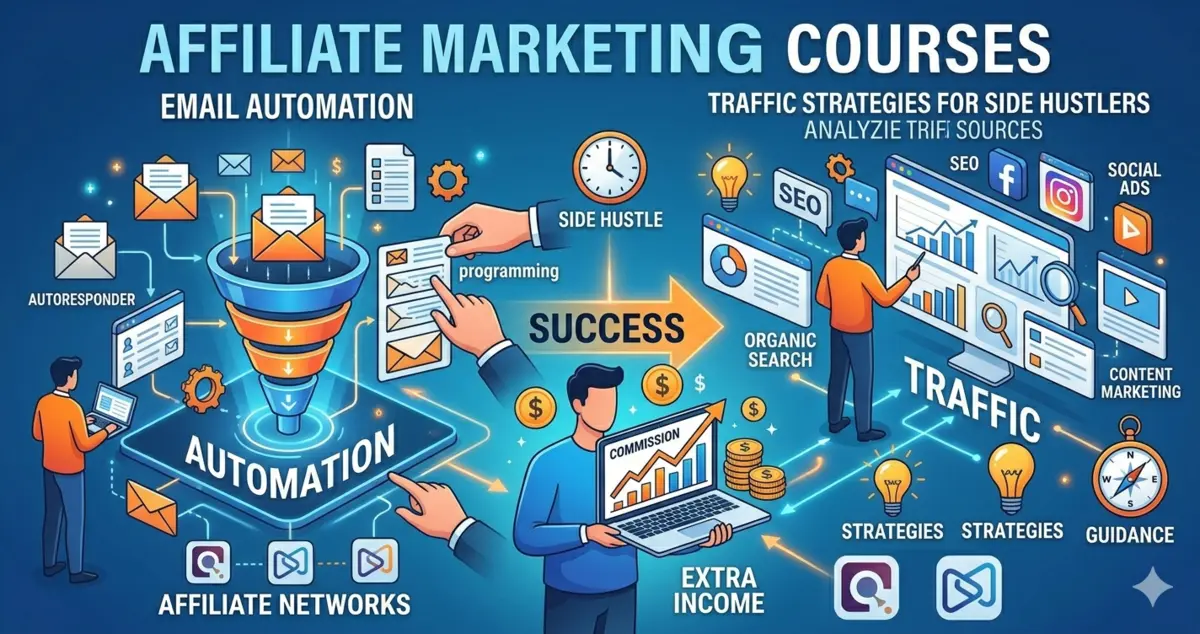
Understanding Affiliate Marketing Courses
Affiliate marketing generates over $8 billion annually in the U.S. alone—yet most side hustlers often capture only a fraction of that potential because they’re operating without a system. Affiliate marketing rewards publishers for driving sales or leads to third-party offers, making it one of the most scalable income models available to anyone with an internet connection and a focused strategy.
The real differentiator isn’t effort—it’s structured knowledge. Affiliate marketing courses compress years of trial-and-error into replicable frameworks, covering traffic acquisition, audience segmentation, and conversion optimization in sequence. An analysis of top programs confirms that the best courses go beyond theory, delivering actionable systems side hustlers can deploy immediately.
In today’s competitive landscape, generic advice no longer moves the needle. Targeted knowledge—specifically around email automation and funnel-building—is what separates consistent earners from those perpetually chasing their first commission. The barriers standing between most side hustlers and that consistency, however, run deeper than strategy alone.
The Problem: Overcoming Barriers for Side Hustlers
Most side hustlers don’t fail at affiliate marketing because they lack motivation—they fail because the learning curve collides head-on with real-world constraints. Time, budget, and technical complexity create a compounding barrier that stops momentum before results materialize.
Time fragmentation is the most cited obstacle. Balancing a full-time job alongside building traffic systems and learning email automation fundamentals leaves little room for error or experimentation. According to Upwork’s affiliate marketing research, the most successful side hustlers prioritize repeatable, systemized workflows over manual daily effort.
Budget constraints compound the problem. Many beginners over-invest in tools before validating an approach—spreading thin across landing page builders, tracking software, and email platforms simultaneously.
The practical solution is narrowing focus: one traffic channel, one funnel, one list-building mechanism. What typically happens with high-performing side hustlers is that they treat the first 90 days as a systems-building phase, not an income phase.
Understanding why these barriers exist sets the stage for recognizing how the right automation infrastructure removes them entirely.
Why Email Automation Matters
Traffic strategies bring visitors to your offers—but without a system to capture and nurture those visitors, most of that effort evaporates. Email automation is the infrastructure that converts one-time clicks into repeat buyers. According to Beehiiv’s affiliate email marketing guide, email consistently outperforms social media in conversion rates, making it the highest-ROI channel available to affiliate marketers.
Automation specifically removes the manual bottleneck. Pre-built sequences deliver targeted messages based on subscriber behavior—welcome flows, product recommendations, re-engagement triggers—without requiring daily intervention. What typically happens is a well-structured funnel compounds over time: each new subscriber enters an evergreen sequence that works around the clock.
Popular platforms enabling this include ConvertKit, ActiveCampaign, and MailerLite—which notably offers list-building tools without a full website. The right platform depends on your niche complexity and segmentation needs.
The core advantage: automation creates scalable engagement without proportional effort—the foundation of genuine passive income.
Traffic Strategies for Sustained Growth
Email automation captures and converts visitors—but only if those visitors keep arriving. Sustainable traffic means building systems that generate consistent, compounding inbound flow rather than relying on unpredictable spikes.
The three core traffic channels each carry distinct trade-offs:
- Organic (SEO): Affiliate marketing SEO compounds over time—content ranks, earns backlinks, and drives free clicks indefinitely. The caveat: results typically take three to six months to materialize.
- Paid traffic: Faster to launch but requires budget discipline and conversion data to stay profitable.
- Social/community: High engagement potential but algorithm-dependent and fragile without an owned channel beneath it.
A practical approach is layering all three—using paid traffic to validate offers quickly while organic content builds long-term authority. Pairing traffic growth with a well-matched affiliate program prevents wasted clicks on low-converting offers.
Consistency beats volume. Understanding which channel fits your niche points directly to which courses are worth your investment—which is exactly what the next section examines.
Courses That Teach Email Automation and Traffic Strategies
Not every affiliate marketing course covers the full stack—most focus on either traffic or monetization, rarely both. The strongest programs integrate a coherent email marketing strategy with traffic systems, so learners build complete pipelines rather than disconnected tactics.
According to Course evaluations, the best programs combine actionable frameworks with documented student outcomes—not just theoretical walkthroughs. When evaluating options, three factors matter most:
- Curriculum depth: Does the course cover list-building, segmentation, and automation sequences—not just broadcast emails?
- Traffic integration: Are organic, paid, and social channels taught as complementary systems?
- Creator credibility: Are instructors active practitioners with verifiable results?
Dreamgrow’s analysis of top-rated courses highlights that price alone is a poor proxy for quality—some free courses outperform paid alternatives in practical applicability. If you’re still mapping out your niche before selecting a course, clarifying your market first prevents costly misalignment. The next section puts these evaluation criteria into context through real-world application scenarios.
Example Scenarios: Applying Course Concepts
Abstract strategies only become valuable once they’re mapped to a specific niche and audience. Here’s what applying course concepts actually looks like in practice.
Example scenario: A side hustler in the personal finance niche builds a lead magnet around a free debt payoff spreadsheet. Paid traffic drives visitors to a landing page; those who opt in enter a drip campaign that delivers daily tips over 14 days, weaving in affiliate offers for budgeting tools at logical moments—when the subscriber has already experienced the problem the tool solves. By day 10, purchase intent is high because trust was built systematically, not assumed.
A fitness blogger, by contrast, might use organic SEO traffic paired with a segmented funnel to route supplement buyers separately from program seekers—delivering hyper-relevant sequences to each group.
The transformation potential is architectural: course-acquired skills don’t just improve one campaign, they create a repeatable system transferable across niches. Knowing how to properly configure triggers, segment audiences, and map content to buyer intent means each new offer you promote starts with infrastructure already in place.
That said, execution gaps are common—and knowing what works in theory doesn’t guarantee avoiding costly missteps in practice.
Common Mistakes to Avoid
Even with solid course concepts in hand, execution errors consistently derail results. The most damaging mistake is treating email automation as optional—launching an email campaign without a nurture sequence means capturing leads that immediately go cold. Research consistently shows that follow-up sequences, not single broadcasts, drive the majority of affiliate conversions.
Traffic mistakes compound quickly:
- Diversifying across five platforms before mastering one
- Driving cold traffic directly to merchant pages instead of a capture-first funnel
- Optimizing for clicks rather than qualified intent
Neglecting proper automation setup creates a ceiling on scalable income—every sale requires manual effort instead of systematic follow-up.
A common pattern: affiliates focus exclusively on traffic volume, assuming more eyeballs solve conversion problems. In practice, misaligned traffic—visitors who don’t match the offer’s buyer intent—converts at fractions of a percent regardless of volume. Course selection matters precisely because these structural errors aren’t obvious until significant time and budget are already spent.
Limitations and Considerations
No course eliminates the core challenge: execution. Even the most structured curriculum for side hustle marketing can’t substitute for consistent, iterative action over time. Before enrolling, consider these realities:
- Courses teach frameworks, not guarantees. Results depend heavily on niche selection, traffic consistency, and list quality—variables no instructor controls.
- Content has a shelf life. Algorithm changes and platform policy updates can render tactics outdated within months of publication.
- Learning curves compound. Email automation, funnel architecture, and traffic systems each carry their own technical complexity.
One practical approach is auditing what skills you already have before purchasing. If you’re solid on building an email audience but weak on offer selection, a general beginner course wastes your investment. Targeted gaps require targeted training. According to Printify’s affiliate course research, the best programs combine strategy with ongoing community access—because continuous learning, not a single course, drives sustainable commission income.
Key Takeaways
The core argument running through this entire discussion is straightforward: organic traffic affiliate strategies and email automation aren’t separate disciplines—they’re two halves of a single conversion system. One drives qualified visitors; the other converts them into buyers over time.
Here’s what deserves immediate action:
- Build the list first. Traffic without capture is wasted. Prioritize lead magnets and opt-in sequences before scaling any traffic channel.
- Automate follow-up sequences. A structured email funnel compounds effort—work done once continues converting while you focus elsewhere.
- Choose courses with specificity. Generic instruction rarely closes skill gaps; structured, framework-driven reviews help identify programs that deliver measurable results.
The most dangerous move is waiting for perfect conditions before starting. In practice, momentum builds only through implementation. Pick one traffic source, pair it with one email tool, and execute consistently.
The next logical question most side hustlers arrive at after solving the system problem: what does realistic daily income actually look like?
How to Make $100 a Day Affiliate Marketing?
Earning $100 daily—roughly $3,000/month—is a realistic benchmark, not a fantasy, provided the underlying system is built correctly. The math is straightforward: promoting a $50 product at a 50% commission requires four sales per day. What separates achievers from aspirers is niche selection and product choice from the outset.
High-commission niches—finance, SaaS, health, and proven ClickBank categories—consistently outperform generic product promotion because average order values are higher and recurring commissions compound over time. Pairing niche authority with email marketing platforms that support behavioral segmentation means your list works continuously, converting warmed leads rather than relying on cold traffic alone. According to Beehiiv’s affiliate email marketing guide, structured email sequences dramatically increase conversion rates compared to single-touch promotion.
The consistent $100/day formula typically involves:
- A focused content engine driving organic search traffic
- A lead magnet converting visitors into subscribers
- An automated email sequence nurturing toward purchase
Consistency, not volume, drives this outcome. Understanding which activities generate disproportionate returns matters far more than working harder—a point the next section addresses directly.
What Is the 80/20 Rule in Affiliate Marketing?
The Pareto Principle holds that 80% of results come from 20% of efforts—and in affiliate marketing, this ratio is remarkably consistent. Most commissions trace back to a handful of high-converting offers, a few evergreen content pieces, and one or two traffic channels that consistently perform.
The highest-leverage 20% typically includes:
- Targeted keyword research affiliate content that captures buyer-intent searches
- A single optimized email sequence converting cold leads into purchasers
- Two or three cornerstone content assets driving the majority of organic traffic
In practice, side hustlers who audit their analytics almost always discover one email campaign or one SEO article generating disproportionate revenue. The strategic move is doubling down there rather than spreading effort across a dozen low-yield tactics.
Tasks that rarely move the needle: social posting without capture mechanisms, building multiple sites simultaneously, or constantly switching niches. These feel productive but occupy the ineffective 80%.
Understanding which activities belong in your high-impact 20% sets the foundation for building a communication infrastructure that scales—exactly what structured marketing systems are designed to identify and amplify.
Introduction to Communication Systems in Affiliate Marketing
Effective communication systems form the connective tissue between traffic and conversions—the exact gap most side hustlers fail to bridge. At their core, these systems coordinate how messaging reaches prospects across email sequences, landing pages, and follow-up triggers in a structured, automated flow.
Targeting low competition keywords within that content layer is one practical approach to attracting qualified traffic without heavy ad spend—visitors who already match your offer’s intent.
When integrated with affiliate efforts, a well-designed communication system transforms scattered clicks into a predictable nurture pipeline. What typically happens is that optimized sequencing lifts conversion rates significantly compared to one-off promotional sends—the difference between a system that compounds and one that merely reacts.
That optimization mindset applies directly to hitting consistent daily revenue targets, which the next section explores in depth.
How to Make $100 a Day With Affiliate Marketing?
Earning $100 daily is achievable—but it requires treating affiliate marketing as a system, not a lottery. In practice, that means stacking three levers simultaneously: high-commission offers, consistent traffic, and automated email follow-up sequences that convert cold leads over time.
The math is straightforward. A $50 commission product requires two daily conversions. With a 2% email list conversion rate, that demands roughly 100 targeted clicks per day—entirely realistic from a 3,000-subscriber list running automated sequences. Continuous optimization separates affiliates who plateau from those who scale: split-testing subject lines, refining call-to-action placement, and pruning underperforming traffic sources compounds results week over week.
Studying the best affiliate marketing courses accelerates this trajectory by revealing which optimization levers move the needle fastest—a critical advantage when time is limited.
Which Course Is Best for Affiliate Marketing?
Choosing the right course comes down to matching curriculum depth against your specific gaps. The strongest evaluation criteria include: practical funnel walkthroughs, coverage of how to automate email marketing (not just theory), traffic strategy diversity, and post-purchase community support.
Content relevance is non-negotiable. A course built around 2019 Facebook ad tactics won’t solve a 2026 conversion problem. Prioritize programs that address sequencing logic, segmentation, and behavioral triggers.
Peer reviews reveal what sales pages hide. Look for verified student outcomes with revenue benchmarks, not generic testimonials. Courses worth investing in show measurable results from part-time practitioners—exactly the profile most side hustlers share.
Can You Do Affiliate Marketing as a Side Hustle?
Absolutely—and it’s one of the more structurally sound side hustles available. According to Upwork, affiliate marketing requires no inventory, no customer support overhead, and scales with automation rather than hours logged. That asymmetry makes it unusually compatible with a packed schedule.
The key is building traffic strategies for affiliates that run without constant manual input—SEO content, email sequences, and evergreen social assets that generate clicks while you’re at work. Part-time marketers who succeed typically dedicate focused 60–90 minute daily blocks to content or funnel optimization rather than scattered effort.
The right course structure matters just as much as the strategy itself—which is worth examining closely next.
Which Course Is Best for Affiliate Marketing?
The honest answer: the best course is the one that stays current, teaches why use email automation as a core revenue strategy—not an afterthought—and pairs instruction with active community support.
Three criteria consistently separate high-ROI programs from outdated ones:
- Regular curriculum updates reflecting algorithm changes and platform shifts
- Community access for accountability and real-time troubleshooting
- Mentorship structures that accelerate the feedback loop between learning and earning
In practice, mentorship compresses the trial-and-error cycle that kills most side hustlers’ momentum. A course without it is essentially a library—useful, but passive. The next decision becomes where you execute those strategies, which makes platform selection equally critical.
What Is the Best Affiliate Marketing Platform? (Community Insights)
Platform choice drives more conversion failures than most side hustlers realize. Community discussions consistently surface three dominant options:
- Amazon Associates – massive product catalog, low commission rates (1–4%)
- ClickBank – digital products, high commissions (up to 75%), strong fit for email funnels
- ShareASale / CJ Affiliate – broad merchant diversity, reliable tracking infrastructure
What Reddit’s r/thesidehustle threads repeatedly confirm: platform selection should follow your email strategy, not precede it. Marketers searching for affiliate marketing courses email automation often discover this after choosing the wrong platform first. ClickBank’s recurring-commission products, for instance, pair naturally with nurture sequences—each follow-up email has a legitimate reason to re-engage. Amazon’s cookie window (24 hours) punishes any funnel with a long warm-up phase.
The practical takeaway: match platform commission structure to your email sequence length before building anything. That framework question—whether to invest in structured guidance or self-learn it—shapes everything that follows.
Should I Buy a Course? Or Can I Really Get Started With Free Resources?
Free resources exist in abundance—YouTube tutorials, blog posts, Reddit threads. The limitation isn’t access; it’s structure. Scattered free content rarely connects traffic strategies for side hustlers into a coherent, repeatable system. Without that architecture, most learners stall between “getting clicks” and “making sales.”
A paid course’s real value is sequencing: knowing what to do first and why it connects to what comes next. That clarity compresses months of trial and error into weeks.
One practical framework: Start with free resources to validate genuine interest, then invest in structured learning once you’re ready to commit. The programs worth exploring—and how to choose among them—come next.
What Are the Best Affiliate Marketing Programs for Getting Started?
Choosing the right program directly impacts your conversion rate before a single email gets sent. The best affiliate courses for beginners consistently point to programs with low friction onboarding, reliable tracking dashboards, and responsive affiliate support teams.
Top entry points by niche:
- Amazon Associates — broad product range, trusted brand recognition
- ShareASale — strong merchant diversity, transparent reporting
- ClickBank — high commissions on digital products, ideal for email funnels
- Impact — enterprise-grade tracking, preferred by scaling side hustlers
Program selection isn’t arbitrary. The right program matches your audience’s existing buying intent—promoting software tools to a tech-skeptical audience produces predictable friction regardless of traffic volume. Misalignment between program and niche is one of the most underdiagnosed reasons conversions stall.
When evaluating programs, prioritize cookie duration, payment thresholds, and whether the merchant provides promotional assets compatible with email automation workflows. The next layer of your education—learning where to deepen these skills—is where dedicated learning platforms become essential.
Is There Any Website Available for Learning Affiliate Marketing?
The short answer: dozens exist. The real question is which resources move you from concept to execution—especially on tactics like side hustle affiliate marketing drip campaigns, where theory alone won’t generate commissions.
A common pattern is combining structured platforms with active communities. Forums like r/affiliatemarketing and niche Facebook groups surface real-world conversion data that no course updates in real time. Staying current matters—algorithm changes and email deliverability shifts can render six-month-old advice obsolete overnight.
Strongest starting points:
- Upwork’s affiliate marketing resource hub for side-hustle-specific frameworks
- YouTube deep-dives for tool walkthroughs
- Industry blogs tracking platform policy changes
The sites providing the most durable value combine structured curriculum with community accountability—not just a library of videos. That combination becomes even more critical when evaluating which programs offer the mentorship infrastructure beginners actually need.
Which Affiliate Programs Are Best for Beginners Who Want to Build With Email?
Program selection matters more than most newcomers realize. Beginner-friendly programs share three traits: low payout thresholds, generous cookie windows, and dedicated affiliate support teams. Amazon Associates, ShareASale, and ClickBank all offer structured onboarding dashboards—but the real differentiator is mentorship access. Programs that pair new affiliates with account managers or active communities consistently produce faster first commissions.
Support infrastructure is the variable most beginners overlook. A program offering 60-day cookies and a responsive affiliate manager outperforms a higher-commission program with zero guidance. That structured backing is what turns early effort into early wins—and ultimately, into the consistent traffic system covered next.
How to Start Making Traffic With Affiliate Marketing?
Traffic generation follows a logical hierarchy: organic first, paid to scale. SEO-optimized content targets buyer-intent keywords and compounds over time—a single well-ranked article can drive leads for years. Social media (short-form video in particular) accelerates early traction without ad spend. Paid traffic via Meta or Google Ads amplifies what’s already converting.
The critical piece most side hustlers miss: tracking from day one. Without UTM parameters and conversion data, you’re flying blind. Analytics reveal which channel actually produces commissions—not just clicks. That insight is what lets you double down intelligently rather than spread effort thin.
As AI tools increasingly automate content creation and traffic optimization, the edge shifts toward those who combine smart targeting with precise measurement—which is exactly where the next generation of affiliate tools excels.
What Are the 5 Best AI Tools to Start Affiliate Marketing?
AI has fundamentally shifted what a solo affiliate marketer can produce and optimize. These five categories deliver the highest leverage:
- AI writing assistants (ChatGPT, Claude) — generate review drafts, email sequences, and ad copy at scale
- AI SEO tools — identify low-competition buyer-intent keywords and suggest on-page optimizations automatically
- AI image and video generators — produce visual content without a design budget
- Predictive analytics platforms — score leads and flag which subscribers show purchase intent signals
- AI-powered email personalization engines — dynamically swap subject lines and CTAs based on behavioral data
Personalization is where AI delivers the clearest ROI. Segmented, behavior-triggered emails consistently outperform batch-and-blast campaigns, and AI handles that segmentation logic without manual intervention. In practice, combining an AI writing tool with a personalization-capable email platform creates a near-automated content-to-conversion pipeline — exactly the kind of system that separates scalable affiliate businesses from time-intensive side hustles.
That automation potential sets the stage perfectly for the next question most advanced marketers ask: how do you wire these tools together so the entire business runs without constant oversight?
How to Automate My Affiliate Marketing Business So It Runs on Autopilot
Automation converts your affiliate operation from a constant time sink into a system that compounds while you sleep. The architecture is straightforward: traffic capture → email sequence → conversion event — each stage triggered automatically without manual intervention.
Core automation stack:
- Lead capture: Landing page + opt-in form connected to your ESP
- Email autoresponder: Pre-loaded nurture and sales sequences firing on schedule
- Content scheduling: Blog posts and social content queued weeks in advance
In practice, a well-built sequence handles objections, builds trust, and delivers affiliate offers — all before you check your inbox in the morning. The side hustler who builds systems scales; the one who manually posts every day plateaus.
The honest caveat: automation requires upfront investment in setup and periodic optimization. Set-and-forget is a myth — sequences need performance reviews quarterly.
Effective communication architecture sits at the foundation of every automated system, which is exactly what the next section addresses in depth.
Communication Systems That Keep Your Affiliate Marketing Cohesive
Consistent messaging across every touchpoint — traffic source, landing page, email sequence, and offer — is what separates campaigns that convert from those that bleed clicks. Unified communication systems ensure each element reinforces the same core promise, reducing friction at every stage of the buyer journey.
Advanced integration means connecting your traffic triggers directly to segmented email flows. When a subscriber enters through a specific lead magnet, they should receive offers aligned to that exact intent — not a generic broadcast. This behavioral alignment consistently lifts conversion rates.
Consistent messaging isn’t just branding — it’s conversion architecture. As you build toward reliable daily income, that disciplined cohesion becomes the foundation every scaling strategy depends on.
How to Make $100 a Day Affiliate Marketing?
Reaching $100/day isn’t a moonshot — it’s a math problem. A single offer paying $50 commission requires two daily conversions; a $25 commission product needs four. The real variable is conversion-optimized traffic volume feeding a proven funnel.
Scaling is where most affiliates stall. In practice, the pattern is: validate one traffic channel, automate its follow-up sequence, then reinvest commissions into paid amplification or content expansion — not lateral diversification into new niches. According to Upwork, affiliate marketers who treat the model as a structured business rather than a side experiment are consistently the ones who hit meaningful daily income thresholds.
Continuous adaptation separates the $100/day earner from the plateau. Algorithm shifts, offer deprecations, and audience fatigue make standing still a regression strategy. The affiliates scaling past that benchmark are consistently investing in skill development — which is exactly why identifying the right course matters as much as executing the right tactic.
Which Course Is Best for Affiliate Marketing?
The best affiliate marketing course isn’t universally defined — it’s the one that closes your specific skill gap. That said, a few criteria consistently separate high-value programs from generic content: integrated traffic and email automation training, actionable frameworks over theory, and measurable outcome benchmarks. According to Course evaluations, the top programs combine technical setup with conversion strategy rather than treating them as separate disciplines.
Course completion itself drives compounding returns. Learners who finish structured programs — rather than cherry-picking modules — develop systems thinking, not just isolated tactics. That’s what converts effort into predictable revenue.
Affiliate marketing also evolves rapidly. Algorithm shifts, platform policy changes, and new automation tools mean a course taken in 2023 may already be partially outdated. Ongoing education — whether through updated course content, community access, or supplemental resources — isn’t optional for anyone serious about scaling.
The strongest programs treat enrollment as the beginning of a learning arc, not the end.
Conclusion: Your Roadmap From Effort to Consistent Commissions
The through-line across every section of this guide is clear: affiliate marketing courses that integrate both email automation and traffic strategies outperform those that teach either skill in isolation. Traffic without a funnel leaks revenue. Email automation without targeted traffic yields an empty list. Side hustlers who master both create a compounding system — not a manual grind.
According to Upwork, affiliate marketing remains one of the most scalable side hustles precisely because automation removes the ceiling on income without multiplying your hours.
The next move is straightforward: identify your current skill gap — traffic acquisition or funnel conversion — then select a course that closes that gap with actionable frameworks, not recycled theory. The right investment now builds the predictable, semi-passive income system that brought you here in the first place.
Related Articles
- Email Marketing for Affiliate Marketers in 2026: The Complete Guide (Tools, Strategy & First Sales)
- What Is ClickBank and How Does It Work for Beginners? (Complete Guide)
- How to Start Affiliate Marketing in 2026 (Ultimate Beginner’s Step-by-Step Guide)
TheReviewLabs Team
Active ClickBank Affiliates · Affiliate Marketing Researchers
We are active ClickBank affiliates who research and test affiliate offers using ClickBank's official marketplace data, Top Offers reports, and real commission performance. All Gravity scores, EPC figures, and payout data in this article are sourced directly from ClickBank's platform as of April 2026. We update this list every two weeks. Learn more about our review process →