If you spend enough time around affiliate marketers, sooner or later the JVZoo vs ClickBank debate shows up. Ask in a Facebook group, browse Reddit threads, or watch a few YouTube videos and you’ll quickly notice something: everyone seems to have a strong opinion. Some marketers swear by JVZoo because of its software launches and high commission offers, while others insist ClickBank is the easier, safer platform to build around — especially if you’re trying to grow with SEO and long-term content.
The problem is that most comparisons leave out context. You’ll hear statements like “JVZoo pays instantly” or “ClickBank is beginner friendly,” and while neither claim is wrong, they barely scratch the surface. Choosing an affiliate platform is less about chasing the highest commission percentage and more about understanding how each platform fits the kind of business you are actually trying to build. A platform that works brilliantly for a marketer with an email list and launch strategy might be frustrating for someone building traffic through Google search.
That is really the question behind this comparison: better for what? Better for beginners? Better for organic traffic? Better for recurring commissions? Better for building an affiliate site that compounds traffic over time? Once you start looking at it that way, the conversation becomes far more useful — and much more honest.
After reviewing how both platforms work, comparing their payout systems, approval processes, product ecosystems, and the kinds of affiliates who tend to succeed on them, one thing becomes very clear: JVZoo and ClickBank are not interchangeable. On the surface they look similar because both help affiliates promote digital products, but in practice they reward very different behaviors.
If you are trying to build a sustainable affiliate business in 2026, choosing the wrong platform can cost you more than just time. It can lead you toward the wrong niche, the wrong traffic strategy, and unrealistic expectations about how affiliate marketing actually works. This guide is designed to help you avoid that mistake and decide which platform genuinely makes sense for your goals.
Quick Verdict: JVZoo vs ClickBank
If you only want the short answer, here it is.
For most beginners, ClickBank is the easier platform to start with. The marketplace is broader, approval friction is lower, and there are more opportunities to create evergreen content around products people continue searching for month after month. If your plan involves SEO, blogging, comparison articles, and organic traffic, ClickBank tends to fit naturally into that model.
JVZoo, on the other hand, often makes more sense for marketers operating in software, online business, and internet marketing spaces. It leans heavily into launches, product promotions, and affiliate campaigns where timing, bonuses, and audience relationships matter. Affiliates who already understand funnels, email marketing, or launch-style promotions may find more upside there.
That doesn’t mean one platform is objectively better than the other. It means each one solves a different problem. ClickBank tends to reward patience and evergreen traffic, while JVZoo often rewards speed, promotions, and marketing execution. Once you understand that distinction, the comparison becomes much easier to evaluate.
How We Compared JVZoo and ClickBank
Before jumping into commissions and payouts, it helps to explain how this comparison was approached. There is a lot of recycled advice online where one platform is labeled “best” without any explanation of why, and that usually leads beginners in the wrong direction. Rather than repeating affiliate clichés, this comparison focuses on practical factors that actually influence whether someone succeeds.
That includes things like payout reliability, commission structure, approval requirements, product quality, refund concerns, SEO suitability, and beginner friendliness. It also considers something that often gets ignored: how realistic it is to generate traffic for the products on each platform. A product paying 90% commission sounds exciting until you realize nobody searches for it or the competition is impossible to break into.
Platform information was checked against the official sites for JVZoo and ClickBank, while practical considerations were evaluated through the lens of long-term affiliate growth, content marketing, and SEO-based monetization. ClickBank continues to position itself as a large digital marketplace spanning multiple niches, while JVZoo remains more concentrated around software launches and internet marketing products.
There is also one important reality worth stating upfront: no affiliate platform makes money for you. The platform matters, but traffic quality, positioning, search intent, and trust matter far more. Someone who understands audience intent and publishes genuinely useful content can outperform affiliates chasing flashy commission screenshots every single time.
What Is JVZoo?
At its core, JVZoo is an affiliate marketplace built around digital products, especially software tools, internet marketing products, business automation systems, AI tools, and make-money-online offers. If you have ever seen launches promising new SEO software, content automation tools, funnel builders, or agency systems, there is a good chance they were promoted through JVZoo.
What makes JVZoo different is the way the platform tends to operate. Rather than relying heavily on evergreen search demand, many promotions revolve around launches and short promotional windows. Affiliates often compete by sending emails, offering bonuses, publishing walkthrough videos, or leveraging audiences they already built. In other words, success on JVZoo often depends less on ranking articles for Google and more on promotion strategy.
This is also where the platform becomes attractive to experienced affiliates. Many products offer unusually high commission percentages, and some vendors allow instant PayPal commissions for approved affiliates. On paper, that can sound dramatically more exciting than waiting for scheduled payouts elsewhere. But there is an important catch: vendors frequently review and approve affiliates manually, which means beginners can hit friction quickly if they have no audience, traffic proof, or promotion strategy.
For someone already comfortable with launches and marketing systems, that friction may not matter much. For a beginner, it can feel confusing and discouraging. That distinction becomes important later when we compare beginner friendliness and long-term sustainability.
What Is ClickBank?
ClickBank works differently, and in many ways feels more approachable to newer affiliates. Instead of concentrating heavily on internet marketing products, ClickBank spans a much broader range of categories including health, fitness, relationships, finance, survival, pets, education, and software. That broader marketplace matters because it creates more opportunities to target evergreen search intent.
If your strategy involves writing content that ranks over time, ClickBank naturally opens more doors. You can build a niche site around supplements, create comparison content in fitness, publish informational articles around relationships, or target long-tail searches connected to everyday problems people actively search for. In practice, this often aligns much better with SEO-driven affiliate strategies.
Another major difference is simplicity. With many ClickBank products, affiliates can start promoting without dealing with manual approval systems. Instead of requesting permission from a vendor, you can usually generate a tracking link and start testing content immediately. That may sound like a small difference, but for beginners it removes a surprising amount of friction.
If your long-term goal is organic traffic, understanding proper keyword research for affiliate marketing and learning practical SEO for affiliate marketing often matters far more than obsessing over which platform advertises the biggest commission percentage. After all, a high-paying offer means very little if nobody ever visits the page promoting it.
JVZoo vs ClickBank: The Difference Most People Miss
When people compare JVZoo and ClickBank, the conversation usually goes in one predictable direction: commissions, payouts, and screenshots of earnings. That makes sense because affiliate marketing content online tends to revolve around numbers. Bigger percentages feel exciting, instant commissions sound impressive, and naturally people want to know where they can make more money.
But after spending enough time around affiliate marketers, it becomes obvious that this is usually the wrong starting point.
The real difference between JVZoo and ClickBank has less to do with how much they pay and more to do with how you plan to grow your business. On the surface they look similar — both let you promote digital products and earn commissions — but in practice they reward very different kinds of marketers.
JVZoo feels much more like a platform built around launches, promotions, and momentum. ClickBank, on the other hand, feels closer to an ecosystem built around evergreen demand and long-term discoverability.
That distinction matters more than most beginners realize.
Imagine two people entering affiliate marketing.
One enjoys researching topics, writing articles, learning SEO, and slowly building traffic through search engines. They are fine with delayed gratification if it means content keeps generating clicks over time.
The second person loves fast-moving opportunities. They enjoy software launches, bonuses, webinars, email promotions, and the excitement of short campaigns where timing matters.
Technically, both people are trying to make money online through affiliate marketing, but realistically they probably should not approach it the same way.
That is where the JVZoo vs ClickBank decision becomes practical instead of theoretical.
Why JVZoo Often Feels Faster
If you spend even a few days inside JVZoo, one thing becomes obvious very quickly: the ecosystem moves fast.
A lot of products revolve around launches. New software tools appear constantly — AI products, automation systems, SEO tools, marketing software, agency platforms, funnel builders — and many affiliates rush to promote them while attention is highest. There is often a sense of urgency built into the platform because launches naturally create short windows where interest spikes.
For marketers who already have audiences, this can work extremely well.
Someone with an email list, a YouTube channel, or an engaged audience can capitalize on that momentum quickly. A good promotion, bonus strategy, or walkthrough video can produce results fast, which explains why some affiliates genuinely prefer JVZoo over slower-moving ecosystems.
But there is another side to that speed.
The same thing that makes launches exciting can also make them difficult to sustain.
A software product people obsess over today may be forgotten next month. Traffic spikes can disappear quickly, competition tends to be aggressive around launches, and keeping momentum often means constantly looking for the next opportunity.
For some marketers, that feels energizing.
For others, it feels exhausting.
Why ClickBank Often Feels More Sustainable
ClickBank tends to operate on a different rhythm.
Instead of depending heavily on launches, many products sit inside evergreen categories where demand rarely disappears. People consistently search for topics related to health, relationships, fitness, finance, pets, self-improvement, sleep, stress, productivity, and hobbies — not because a launch created hype, but because these are ongoing problems people genuinely want help solving.
That changes the way affiliate marketing feels.
Rather than chasing attention, you are often trying to build visibility over time.
You begin asking questions like:
What are people already searching for?
What problems exist year-round?
Which topics could still bring traffic six months from now?
This is one reason ClickBank often feels more natural for SEO-driven affiliate sites.
If someone searches for:
best supplement for gut health
or
how to stop dog separation anxiety
that intent exists whether or not a product launched yesterday. A helpful article targeting those kinds of searches can quietly attract traffic for months or even years if it stays useful and relevant.
That does not mean ClickBank is easier.
SEO still takes patience. Content still takes work. Competition still exists.
But the underlying model tends to reward consistency rather than speed.
If organic traffic is your long-term strategy, learning real keyword research for affiliate marketing and understanding practical SEO for affiliate marketing will usually move the needle far more than obsessing over which affiliate platform advertises the highest percentage payout.
Because realistically, even the highest-paying commission is meaningless if nobody ever finds your content.
So Which Model Fits You Better?
This is probably the most honest question you can ask yourself before choosing a platform.
If you enjoy writing, researching, comparing products, and slowly building authority through organic traffic, ClickBank will probably feel more aligned with how you naturally work. The platform simply creates more opportunities for evergreen content and long-tail search intent.
If you prefer launches, faster promotions, email campaigns, bonuses, software demos, or internet marketing products, JVZoo may feel far more exciting and potentially more profitable.
Neither approach is wrong.
The mistake most beginners make is chasing excitement instead of alignment.
People see headlines promising instant commissions or unusually high payouts and assume that automatically means easier money. In reality, the platform that works best is usually the one that matches the kind of work you can realistically keep doing for the next year.
That sounds less exciting than commission screenshots, but it is usually much closer to the truth.
JVZoo vs ClickBank Commissions: Which One Actually Pays More?
This is where expectations often collide with reality.
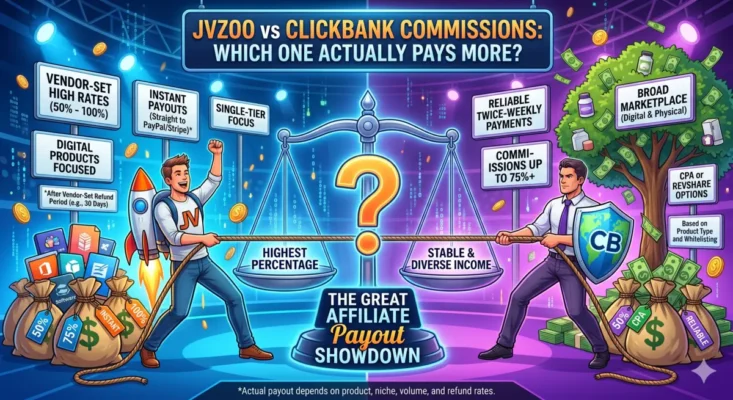
On paper, JVZoo can look incredibly attractive. Some products advertise very high commission percentages, sometimes even paying 100% on front-end offers while relying on upsells and recurring revenue behind the scenes. For affiliates who understand launches and already know how to generate attention quickly, those numbers can absolutely translate into strong earnings.
But commission percentages can be deceptive.
A product paying 75% commission sounds impressive until you realize getting visibility for that product may be difficult, competition is intense, or buyers simply do not trust the offer enough to convert.
ClickBank often looks quieter by comparison, but many offers still pay extremely well — especially in evergreen markets where people continue searching for solutions month after month. Health, relationships, personal improvement, and finance products may not always feel flashy, but they often benefit from consistent intent.
That is why experienced SEO affiliates tend to think about commissions differently.
Instead of asking:
Which platform pays the highest percentage?
they ask:
Which platform gives me the best chance to generate consistent traffic and repeat sales?
Because over time, consistency tends to outperform excitement.
Approval Process: Why Beginners Usually Have a Much Easier Time With ClickBank
One thing people rarely mention when comparing affiliate platforms is friction. Not technical friction, but emotional friction — the small things that quietly slow you down when you are trying to learn affiliate marketing. This matters more than most people realize because beginners usually quit long before traffic or commissions become the real problem. They quit because the process starts feeling confusing, discouraging, or unnecessarily complicated.
This is where ClickBank and JVZoo feel very different in day-to-day use.
With ClickBank, the experience is usually straightforward. You browse products, choose an offer, generate your affiliate link, and begin promoting. There is rarely much standing between you and execution. If your goal is writing content, publishing reviews, or experimenting with organic traffic, that simplicity becomes surprisingly valuable because you can spend more time learning marketing and less time waiting for permission.
JVZoo often works differently.
A lot of products require affiliate approval before you can promote them. In theory, that sounds reasonable — vendors want to protect their products from spam traffic, misleading promotions, or affiliates making unrealistic promises. But if you are new, the experience can feel frustrating because you suddenly realize getting access is not automatic.
Many beginners run into the same situation.
They create an account, find a product that looks exciting, click “request approval,” and assume they are ready to start. Then nothing happens. Sometimes approval comes quickly, sometimes it never arrives, and sometimes vendors want proof of how traffic will be generated before allowing promotion.
That gap between expectation and reality catches people off guard.
It is easy to interpret silence as rejection or assume something is broken when, in reality, vendors are simply being selective. Experienced affiliates with audiences, email lists, YouTube channels, or proven traffic sources often move through this process without much friction because they already know how to position themselves.
For someone still figuring things out, though, the experience can feel discouraging.
This is one of the biggest reasons ClickBank often feels more beginner friendly. The platform removes a lot of early friction and allows people to focus on the fundamentals: understanding search intent, choosing better topics, writing stronger content, and learning what makes people actually click and buy.
That does not mean ClickBank guarantees success — far from it. You can still pick weak products, target the wrong keywords, or publish content nobody searches for. But at least the platform itself is not slowing momentum before you even begin.
If your long-term plan is SEO, momentum matters more than people think.
Being able to test ideas quickly, publish content consistently, and learn through repetition tends to matter far more than finding the “perfect” affiliate platform on day one. That is one reason learning practical keyword research for affiliate marketing and building a real understanding of SEO for affiliate marketing usually creates better long-term results than obsessing over commission percentages.
Product Quality: The Honest Conversation Most Affiliates Avoid
This is probably the section people dislike hearing about because it forces a more uncomfortable conversation.
Neither JVZoo nor ClickBank is perfect.
That may sound obvious, but affiliate marketing content online sometimes creates the impression that a platform itself guarantees quality. In reality, both marketplaces contain excellent products, mediocre products, and offers that probably should be approached more carefully.
The difference is often in how the ecosystems feel.
JVZoo has long been associated with internet marketing products, software launches, automation tools, and make-money-online systems. Some of those products are genuinely useful. Others feel heavily promoted, overhyped, or built around urgency more than long-term value. Spend enough time around launch culture and you eventually start recognizing that excitement does not always equal quality.
That does not mean JVZoo is unreliable or full of bad offers.
It simply means product selection matters — arguably more than on broader marketplaces.
A tool that solves a real problem, has transparent positioning, and serves a clear audience can convert extremely well while still protecting trust. On the other hand, aggressively promoted software promising unrealistic outcomes can damage credibility quickly, especially if visitors feel disappointed after purchasing.
ClickBank has its own version of this problem.
Because the marketplace spans health, wellness, fitness, finance, relationships, survival, and self-improvement categories, quality varies enormously. One common mistake beginners make is assuming high gravity automatically means high quality. Sometimes a high gravity score simply means a product is popular among affiliates — not necessarily that customers love it or that it fits your audience particularly well.
That distinction matters if you are building traffic through search.
A person landing on a review article from Google is often more skeptical than someone clicking a launch email. Trust becomes part of the conversion process. If recommendations feel careless, exaggerated, or disconnected from the audience’s real problem, conversions usually suffer over time.
This is one reason product selection matters more than platform selection.
A thoughtful affiliate promoting genuinely useful products on either platform will almost always outperform someone chasing hype without thinking about audience fit. If you are still deciding where to begin, looking at realistic opportunities inside guides like the best ClickBank products to promote is usually smarter than blindly following commission screenshots or marketplace trends.
Which Platform Feels More Trustworthy?
Trust is difficult to measure, but it quietly shapes how affiliate marketing works.
For many people, ClickBank simply feels more familiar. The platform has existed for years, spans broader categories, and often aligns naturally with informational content people already search for. Reading a review about a supplement, relationship product, or financial education offer often feels relatively normal because the surrounding context makes sense.
JVZoo can feel different.
Because the ecosystem leans heavily toward launches, software, and internet marketing tools, promotions sometimes feel more aggressive. Bonuses, countdown timers, launch pages, and urgency tactics appear more frequently, which can create a very different experience for users depending on how the offer is presented.
That does not automatically reduce trust.
For marketers operating inside software or business niches, this style can feel completely normal. But if your strategy revolves around long-term authority, SEO traffic, and building credibility over time, presentation matters more than many affiliates initially expect.
People rarely buy from websites they do not trust.
And in affiliate marketing, trust compounds. A good recommendation today makes future recommendations easier. A poor recommendation, even one with high commissions, quietly damages long-term credibility.
That is why the better question is rarely:
“Which platform pays more?”
Instead, it is often:
“Which platform helps me build something sustainable without sacrificing trust?”
That tends to be the more useful question once the excitement fades and long-term growth becomes the goal.
JVZoo vs ClickBank for SEO and Organic Traffic: Which One Makes More Sense?
If your plan is to build an affiliate business through Google traffic rather than paid ads or email promotions, this is probably the section that matters most.
A lot of affiliate advice online quietly assumes everyone is running launches, buying traffic, or emailing subscribers every day. In reality, many people entering affiliate marketing are trying to build something slower but more sustainable — publishing articles, ranking for keywords, and gradually growing traffic over time. If that sounds like your approach, the difference between JVZoo and ClickBank becomes much easier to understand.
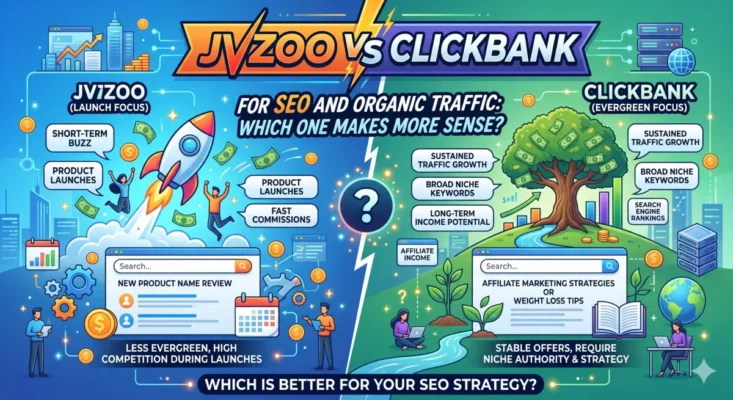
ClickBank generally feels more natural for SEO because the marketplace sits inside categories people already search for every day. Health, fitness, relationships, finance, sleep, self-improvement, pets, parenting, productivity — these are topics with steady demand. People wake up and search for solutions to those problems regardless of whether an affiliate promotion exists. That creates a foundation for evergreen traffic, which is exactly what SEO affiliates depend on.
Imagine someone searching:
“best supplement for menopause fatigue”
or
“how to stop emotional eating naturally”
Those searches happen because a person already has a problem and is actively looking for help. That is the kind of intent Google tends to reward when content is useful, well-structured, and genuinely solves something. Over time, one article becomes ten, ten become fifty, and traffic begins compounding in ways that feel slow at first but surprisingly powerful later.
JVZoo can absolutely work with SEO too, but the traffic model often looks different.
Because the platform leans heavily toward software, automation tools, AI products, and digital marketing launches, search intent tends to cluster around reviews, comparisons, tutorials, and launch-related content. You are more likely to target phrases like:
“best AI video creator tool”
or
“X software review”
instead of evergreen lifestyle problems.
That does not automatically make it worse.
It just creates a different rhythm.
Software-related keywords can convert very well, especially when buyer intent is strong. Someone searching for a software comparison or review is often close to making a decision. But the challenge is that software spaces tend to attract aggressive affiliates, faster-moving trends, and higher competition around launches.
That means content sometimes ages faster.
A software everyone talks about today may disappear six months later. Features change, alternatives emerge, and interest shifts quickly. Evergreen markets inside ClickBank, while not perfect, often move at a slower pace.
For affiliates relying on search engines, that difference matters.
If you enjoy writing in-depth articles, building topical authority, and creating content libraries that strengthen one another, ClickBank often creates more opportunities. For example, one health article can naturally support another. A relationship guide links into product reviews, which link into informational content, gradually creating a stronger site architecture over time.
This is also where internal linking quietly becomes powerful.
Someone reading about affiliate platforms today may later need help understanding keyword research for affiliate marketing or practical SEO for affiliate marketing before commissions become realistic. Building those supporting resources around money pages tends to outperform thin affiliate reviews that exist only to rank for product names.
The honest answer?
If your goal is long-term organic traffic, ClickBank usually fits more naturally.
If your goal is software reviews, launch promotions, marketing tools, and faster-moving digital products, JVZoo may feel like a stronger fit.
Neither approach is wrong, but trying to force yourself into the wrong traffic model usually creates frustration.
Which Platform Is Better for Beginners?
This question comes up constantly, and most answers online oversimplify it.
People usually say:
“ClickBank is easier.”
While that is often true, the reason matters.
ClickBank feels easier because it removes friction.
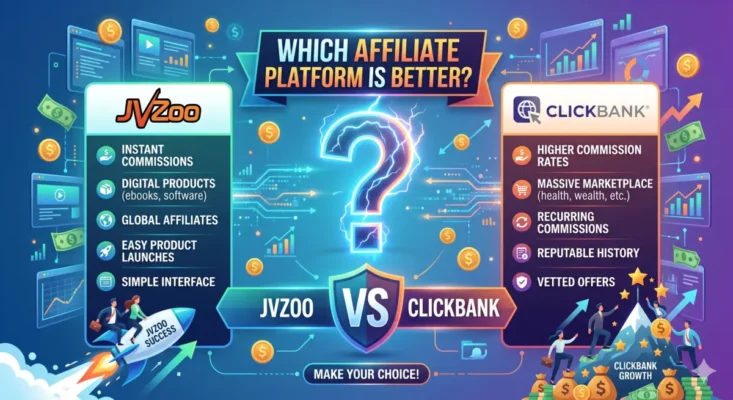
You generally do not spend much time asking vendors for approval, proving traffic sources, or navigating launch ecosystems before getting started. A beginner can sign up, explore offers, and begin experimenting with content much faster. That speed matters because affiliate marketing has a steep learning curve, and repetition is often what teaches you the fastest.
The first few months are rarely about maximizing profit.
They are about learning.
Learning search intent.
Learning what makes people click.
Learning what kinds of pages convert.
Learning which topics quietly attract traffic.
The easier it is to publish, test, and improve, the faster you build experience.
JVZoo can feel harder early on because beginners sometimes expect immediate momentum and instead run into approval barriers or competitive launches where experienced marketers already dominate attention. Someone without traffic, an audience, or a promotion strategy may struggle to understand why things feel slow.
That does not mean beginners should avoid JVZoo forever.
It simply means expectations matter.
For someone already interested in software, digital tools, YouTube tutorials, or online marketing niches, JVZoo might actually feel exciting and worth learning. But if you are trying to build an SEO-first affiliate business, ClickBank usually gives more room to learn without unnecessary friction.
In many ways, the better question is not:
“Which platform is easiest?”
It is:
“Which platform matches how I actually want to build traffic?”
Because that answer tends to be much more useful over the long term.
JVZoo vs ClickBank for Different Types of Affiliates
By this point, the comparison becomes less about “better” and more about fit.
If you are someone who likes writing, researching topics, ranking articles, and gradually building organic visibility, ClickBank will usually feel more aligned. The broader marketplace creates more opportunities to build evergreen content and target long-tail searches that continue bringing visitors over time.
If you enjoy launches, bonuses, software reviews, tutorials, email campaigns, or digital marketing tools, JVZoo may feel far more exciting. Affiliates who thrive in fast-moving environments often appreciate the pace and promotional energy around launches.
There is also a middle ground many people overlook.
Some affiliates quietly use both.
They build long-term traffic through SEO and evergreen ClickBank content while selectively promoting software or marketing tools from JVZoo when opportunities make sense. In practice, that balanced approach often ends up feeling more realistic than treating affiliate marketing like a one-platform decision.
The biggest mistake is assuming one platform automatically guarantees success.
Traffic quality, trust, content usefulness, and consistency matter more than the logo on the affiliate dashboard. Over time, those fundamentals usually matter far more than whichever platform initially looked more exciting.
Should You Use Both JVZoo and ClickBank?
Once people spend a little time comparing affiliate platforms, they often assume they need to choose one side and commit to it completely. In reality, that is not always how affiliate businesses evolve.
A lot of successful affiliates quietly end up using multiple platforms — not because they are chasing every opportunity, but because different traffic strategies naturally lead to different monetization options. Someone building an SEO-focused site around evergreen problems might lean heavily on ClickBank for health, relationships, or education products, while still occasionally using JVZoo when a genuinely useful software tool fits the audience.
Think about someone writing content for affiliate marketers.
They may publish evergreen articles around SEO, keyword research, blogging, automation, or email marketing. In that situation, software tools promoted through JVZoo could fit naturally because readers are already interested in improving workflows or growing revenue. A detailed software review, comparison, or walkthrough may feel completely relevant.
On the other hand, someone building a health niche website would probably struggle to justify random software launches. Visitors reading about nutrition or sleep problems are not expecting marketing funnels or AI content tools. Context matters more than commission size, which is something many beginners overlook when they start browsing affiliate marketplaces.
This is one reason the “best affiliate platform” question can sometimes become misleading.
The better question is often:
Which platform fits the audience I am trying to serve?
That shift in thinking usually leads to better decisions because affiliate marketing becomes less about chasing payouts and more about solving problems people already care about.
If you are still exploring marketplaces, it is also worth looking beyond this comparison. Platforms like Digistore24 Review 2026 sit somewhere in between, offering digital products while feeling different from both ClickBank and JVZoo depending on niche and promotion style.
Common Mistakes People Make When Choosing Between JVZoo and ClickBank
One of the easiest ways to waste time in affiliate marketing is choosing a platform for the wrong reasons. And unfortunately, a lot of advice online unintentionally pushes beginners toward bad decisions because it emphasizes hype over fit.
The first mistake is chasing commission percentages without thinking about traffic.
A beginner sees a software launch paying 75% commission and immediately assumes that is the smartest option. But if the audience is highly competitive, approval is difficult, or traffic is nearly impossible to generate, the high commission stops mattering very quickly. In practice, a smaller commission on a product people actively search for often ends up producing more revenue over time.
The second mistake is confusing hype with opportunity.
JVZoo launches can feel exciting because everything moves quickly. There are launches, bonuses, countdowns, affiliates talking about commissions, and a constant sense of momentum. But momentum alone is not strategy. Sometimes the quiet, boring article ranking for a long-tail keyword quietly outperforms a flashy launch that disappears after a few weeks.
Another common mistake is trying to promote products nobody understands.
This happens more often than people admit. Someone signs up for a platform, grabs affiliate links, and starts recommending products they barely researched. Readers can usually sense that immediately. Trust suffers, conversions fall, and frustration grows.
The better approach is simpler.
Promote products you understand, topics you are willing to spend time learning, and problems people are already searching for.
That advice sounds less exciting than “instant commissions,” but it tends to age much better.
So, Which Platform Is Actually Better?
At this point, the frustrating answer is probably also the honest one:
It depends on how you want to build your business.
If someone asked me which platform I would recommend to a complete beginner trying to learn affiliate marketing through content and organic traffic, I would probably lean toward ClickBank. Not because it is perfect, but because it creates more room to learn. The broader niches, easier approvals, and stronger evergreen search opportunities make the learning curve feel less punishing.
If the same person already had an audience, understood launches, enjoyed software products, or liked internet marketing niches, the answer would probably change. JVZoo begins making more sense when someone already knows how to capitalize on speed, promotions, and momentum.
The mistake is assuming one platform universally wins.
That is rarely how affiliate marketing works.
What succeeds for a marketer running webinars and software launches may fail completely for someone building a niche SEO site. Likewise, a slow, content-driven strategy may frustrate someone who enjoys faster campaigns and promotions.
In many ways, the better question becomes:
What kind of affiliate business do I actually want to build?
Because once you answer that honestly, the decision between JVZoo and ClickBank usually becomes much easier.
Frequently Asked Questions About JVZoo vs ClickBank
Is JVZoo better than ClickBank?
Not necessarily. JVZoo tends to work better for launch-style promotions, software tools, and affiliates who already understand email marketing or audience building. ClickBank often feels easier for beginners and tends to align more naturally with evergreen SEO strategies and long-term content sites.
Is ClickBank better for beginners?
For most beginners, yes. ClickBank removes a lot of friction because many offers do not require affiliate approval, and the marketplace spans broader evergreen categories that work well with content marketing and search traffic.
Can you use both JVZoo and ClickBank together?
Absolutely. Many affiliates quietly combine both depending on audience and niche. Someone focused on affiliate marketing, SEO, or software may naturally recommend tools from JVZoo while still promoting evergreen ClickBank products when relevant.
Which platform pays higher commissions?
JVZoo sometimes advertises extremely high commission percentages, especially around launches and software products. However, higher percentages do not always equal higher earnings. ClickBank products often benefit from steadier demand and recurring search traffic, which can create more consistent results over time.
Which platform works better for SEO?
For most affiliates focused on organic traffic, ClickBank tends to create more opportunities because of its broader evergreen niches. JVZoo can still work for SEO, especially around software reviews and comparisons, but the ecosystem often moves faster and becomes more competitive around launches.
Final Verdict
After comparing commissions, product quality, payouts, approval systems, beginner friendliness, and long-term traffic potential, the simplest conclusion is this:
ClickBank usually makes more sense for beginners and SEO-focused affiliates.
JVZoo often makes more sense for marketers comfortable with launches, software promotions, and faster-moving campaigns.
Neither platform is perfect, and neither guarantees results.
In the end, affiliate marketing success tends to come down to something much less glamorous: choosing products people genuinely care about, creating content that solves problems, and staying consistent long enough to learn what actually works.
That answer may sound less exciting than commission screenshots or overnight success stories, but it is usually much closer to reality.
📘 Want the Full System in One Place?
If you'd rather have a complete step-by-step plan in your hands — including a 30-day content calendar, email sequence templates, and the exact keyword strategy behind this blog — I wrote it all out in the 📘 Book available on Amazon. It's the system behind everything you're reading here.
📘 30-Day Affiliate Marketing Roadmap Edition 1 → Check it out on Amazon.
📘 Affiliate Marketing SEO Roadmap Edition 2 → Check it out on Amazon.
TheReviewLabs Team
Active ClickBank Affiliates · Affiliate Marketing Researchers
We are active ClickBank affiliates who research and test affiliate offers using ClickBank's official marketplace data, Top Offers reports, and real commission performance. All Gravity scores, EPC figures, and payout data in this article are sourced directly from ClickBank's platform as of April 2026. We update this list every two weeks. Learn more about our review process →